Small or hollow ice cubes from a portable ice maker almost always trace to one of four things: a low water reservoir, a cycle cut short by a timer or sensor issue, mineral scale restricting water flow, or occasionally an unlevel unit. These are not the water-inlet-valve or auger-motor problems that cause hollow cubes in a built-in refrigerator ice maker — portable units have their own, simpler set of causes.
Key takeaways
- All four portable-unit manuals we checked use the same basic mechanism: water is pumped into a tray under rod-shaped evaporator fingers, and ice freezes onto the rods. That’s why portable-unit cubes are naturally hollow or cup-shaped, even when everything is working correctly.
- A reservoir dropping toward empty is the best-documented cause across manufacturer manuals — every one of them includes a low-water indicator for exactly this reason.
- Mineral scale restricting water flow is a logical explanation based on how these machines work, but it’s an inference, not something any manufacturer manual directly states as a hollow-cube cause. We’ve flagged it as such below.
- Built-in refrigerator ice makers have entirely different hollow-cube causes (a faulty water inlet valve, a worn ice mold assembly, a harvest motor issue) that simply don’t apply to a portable countertop unit.
Why portable ice cubes are naturally hollow or cup-shaped
Before troubleshooting anything, it helps to know what “normal” looks like. In all four manufacturer manuals we reviewed, the machine works the same basic way: a pump sends water up into a tray sitting above (or below, depending on orientation) a set of rod-shaped evaporator “fingers.” The fingers get cold, water freezes onto them in layers, and the finished ice is harvested off the rods once the cycle ends.
Because ice forms around a rod rather than filling a solid cube mold, portable-unit ice is inherently a little hollow or cup-shaped in cross-section — that’s the mechanism, not a defect. A brand support article on this exact topic (used here as one corroborating source, not as our only source for the claim) describes hollow or thin-walled cubes as what happens when that mold doesn’t fill completely during the freeze cycle, which lines up with the mechanical description in the manuals themselves.
Cause-and-fix table: what makes hollow cubes worse on a portable unit
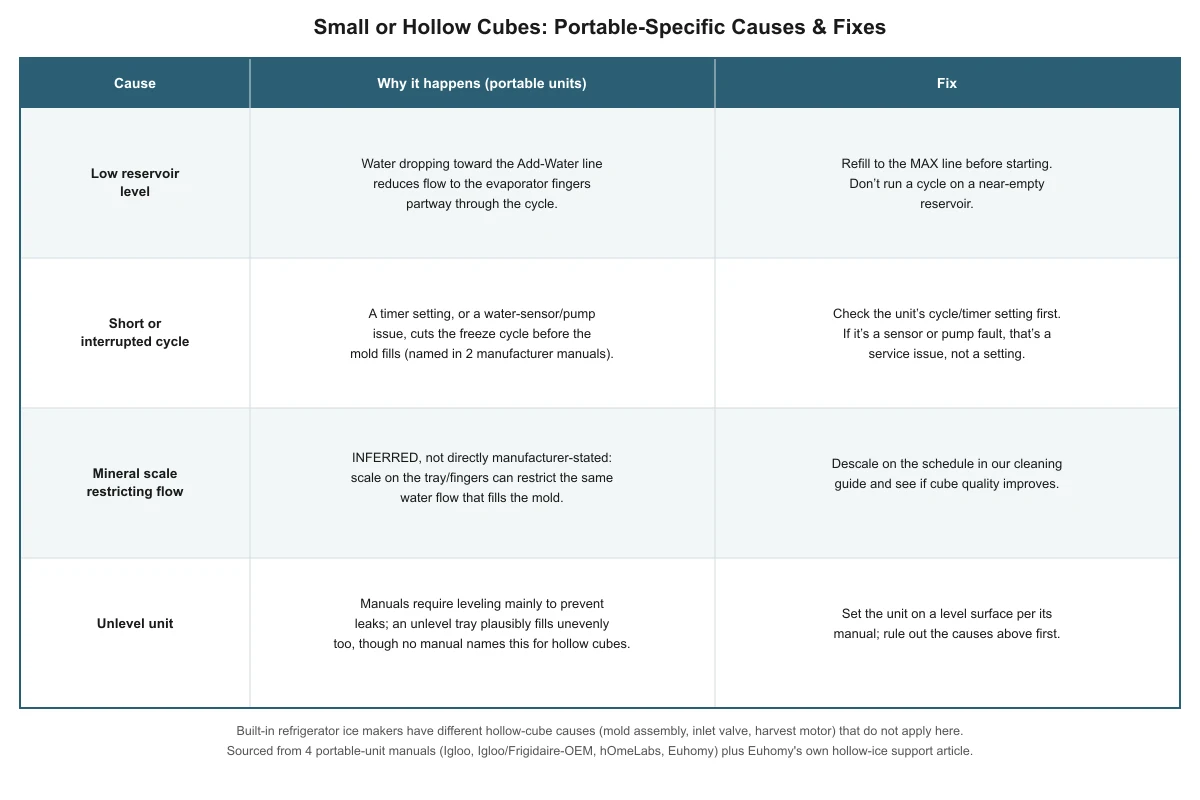
The table below focuses on what pushes normal hollow-ish cubes into genuinely thin, weak, or undersized ice — and what to do about each cause.
| Cause | Why it happens (portable units) | Fix |
|---|---|---|
| Low reservoir level | Water dropping toward the Add-Water line reduces flow to the evaporator fingers partway through the cycle. | Refill to the MAX line before starting. Don’t run a cycle on a near-empty reservoir. |
| Short or interrupted cycle | A timer setting, or a water-sensor/pump issue, cuts the freeze cycle before the mold fills — named directly in two manufacturer manuals. | Check the unit’s cycle/timer setting first. If it’s a sensor or pump fault, that’s a service issue, not a setting. |
| Mineral scale restricting flow (inferred, not manufacturer-confirmed) | Scale on the tray or fingers can plausibly restrict the same water flow that fills the mold, based on how the mechanism works — no manual explicitly names this as a hollow-cube cause. | Descale on the schedule in our cleaning and descaling guide and see if cube quality improves. |
| Unlevel unit | Manuals require leveling mainly to prevent leaks and malfunction; an unlevel tray plausibly fills unevenly too, though no manual names this specifically for hollow cubes. | Set the unit on a level, flat surface per its manual. Rule out the more-confirmed causes above first. |
Cause 1: low reservoir level
This is the single most-documented cause in our source set. Every manufacturer manual we reviewed includes some version of an “Add Water” or low-reservoir indicator, specifically because running the pump with too little water in the tank reduces how much reaches the evaporator fingers during the cycle. The fix is straightforward: refill to the MAX line before starting a cycle, and don’t try to squeeze one more batch out of a reservoir that’s nearly empty.
Cause 2: a short or interrupted cycle
Two manufacturer manuals point to this directly, though from different angles. One names “air in the lines” as a cause of the unit misreading its own cycle progress. Another’s manufacturer FAQ addresses hollow or thick ice stuck to the tray directly, attributing it to the ice-making time being set too long or the ambient temperature running low, and recommends adjusting the machine’s timer setting as the fix. If your unit has an adjustable cycle length, that’s worth checking before assuming a part has failed.
Cause 3: mineral scale restricting flow (the inferred cause)
This one needs an honest caveat. None of the four manufacturer manuals in our source set states outright that scale buildup causes hollow or small cubes. What they do establish is the mechanism: water has to flow freely to the evaporator fingers for the mold to fill completely. It’s a reasonable inference — not a confirmed manufacturer claim — that mineral scale restricting that same water path could produce a partially filled, hollow-feeling cube, the same way a restricted path from low water does. If you’re on hard water and haven’t descaled recently, it’s worth ruling out alongside the more directly documented causes. See our guide to cleaning and descaling a portable ice maker for a schedule based on your water hardness.

Cause 4: an unlevel unit
Every manual that addresses placement tells you to keep the unit level and limit how far it’s tilted during setup, transport, or use. The stated reason in those manuals is mostly about preventing leaks and general malfunction, not specifically about ice shape — but it’s a reasonable extension of the same water-flow logic above: a tilted tray could plausibly fill unevenly. Treat this as a lower-probability cause to check after you’ve ruled out low water and a short cycle, not as the first thing to test.
How is this different from a built-in refrigerator ice maker’s hollow cubes?
Most of what you’ll find searching “hollow ice cubes” online is written for the ice maker built into a refrigerator or freezer door, and it points to causes that simply don’t exist in a portable countertop unit: a faulty water inlet valve, a worn or cracked ice mold assembly, or a failing harvest/ejector motor. A portable unit has no inlet valve (you fill it by hand) and no separate mold assembly in the same sense — it’s the evaporator-finger mechanism described above. If a guide tells you to check a water inlet valve on a countertop ice maker, that advice doesn’t apply to your machine.
When to stop troubleshooting cube shape and check something else
If cubes are coming out noticeably smaller or more hollow than when the unit was new, work through the table above in order: water level, cycle timing, scale, then leveling. But if the unit has stopped producing any usable ice at all — not just smaller cubes, but none — that’s a different problem with a different diagnostic path. See our full portable ice maker not making ice troubleshooting guide, which covers power, water sensing, temperature, and when a refrigerant issue means it’s time to call a technician.
And if you’re still deciding which unit to buy and want one less prone to these issues, our portable ice maker buying guide covers capacity, drain type, and footprint by use case.
Frequently asked questions
Is it normal for every batch of ice to look a little hollow?
Yes. Because these machines freeze water onto rod-shaped evaporator fingers rather than filling a solid mold, some degree of hollow or cup-shaped cube is expected, even from a perfectly functioning unit. The concern is cubes that are noticeably smaller, thinner, or more hollow than usual, not a slight cup shape on an otherwise solid cube.
Can using filtered or distilled water fix hollow ice cubes?
Not directly. One manufacturer’s FAQ links water quality to cloudy-looking ice, not to hollow or undersized cubes — filtered or distilled water can make cubes look clearer, but it won’t fix a flow restriction caused by low water, scale, or a short cycle. Treat clarity and shape as two separate issues.
Does a bigger reservoir mean fewer hollow cubes?
Not necessarily by itself, but it does reduce how often you’re running a cycle on a nearly empty tank, which is the best-documented cause of undersized cubes. Keeping any size reservoir topped up to the MAX line matters more than the reservoir’s total capacity.
My cubes are hollow and the unit is also leaking. Are these related?
They can share a root cause. An unlevel unit, for example, appears in both our hollow-cube causes above and in manufacturer-documented leak causes. If you’re seeing both issues together, check our buying guide for footprint and placement guidance, and level the unit before troubleshooting either symptom further.
Sources
- Igloo IGLICEB26WH Automatic Ice Maker owner’s manual, distributed by Nostalgia Products LLC — manufacturer manual (PDF).
- Igloo ICE108 owner’s manual (distributed with a Frigidaire-branded countertop unit; OEM/white-label manual) — manufacturer manual (PDF).
- hOmeLabs HME0096 “Bullet Ice” portable ice maker manual, hOmeLabs LLC — manufacturer manual (PDF).
- Euhomy IM-03S ice maker manual, including manufacturer Q&A on hollow and thick ice, Euhomy — manufacturer manual (PDF).
- Euhomy knowledge-base article on hollow ice cubes (brand support content, used once as a corroborating source) — why ice makers make hollow ice cubes.
portableicemakerly.com Editorial Team. Last updated: November 13, 2026.


2 thoughts on “Portable Ice Maker Making Small or Hollow Ice Cubes”