Clean a portable ice maker by draining it, wiping the reservoir and basket with soapy water or a vinegar-dampened cloth, rinsing twice, and running a plain-water cycle. Manufacturers don’t publish one vinegar ratio for a soak; Euhomy, the only brand with a published cleaning schedule in our research, recommends weekly cleaning and draining every three days with regular use.
- No manufacturer manual in this research gives a single standard vinegar ratio — two skip vinegar entirely and use plain soapy water instead.
- The one full cleaning cadence any brand actually publishes comes from Euhomy: clean at least weekly with frequent use, and drain the water at least every three days.
- Two of the four manuals describe wiping the interior with a cloth dampened in vinegar, not soaking the machine in a vinegar solution.
- Hard water accelerates mineral scale buildup, so lean toward the more frequent end of the schedule below if that’s your water.
- Already seeing fuzzy spots instead of white crust? That’s a different problem — see our mold and mildew prevention guide instead.
What do manufacturers actually say about cleaning a portable ice maker?
Less than most cleaning blogs claim, and it varies more between brands than you’d expect. We read four manufacturer owner’s manuals for portable countertop ice makers — Igloo’s IGLICEB26WH, the Igloo ICE108 manual used for a rebadged Frigidaire-branded unit, hOmeLabs’ HME0096, and Euhomy’s IM-03S — and found real disagreement on the basics.
Igloo’s manual calls for warm soapy water only, with no mention of vinegar anywhere in the cleaning section. hOmeLabs’ manual is the same: diluted detergent and warm water, wiped on with a soft cloth. Euhomy is the outlier — its own FAQ recommends “lemon water or weak acid vinegar for cleaning,” and its formal cleaning steps combine a detergent-based machine cycle with a separate vinegar-dampened wipe of the interior. None of the four gives an exact mixing ratio for vinegar, and none describes submerging parts in a vinegar bath.
Is there a correct vinegar ratio for cleaning a portable ice maker?
Not one that any manufacturer in this research publishes for this specific appliance. You’ll find cleaning blogs quoting a fixed ratio like one part vinegar to a set amount of water, presented as if it were a standard. We could not verify that figure against Igloo, hOmeLabs, Euhomy, or the Igloo ICE108 manual, so we’re not repeating it here as fact.
What you can honestly do is one of two things, both grounded in real manufacturer instructions. First, the baseline every brand agrees on: wipe the basket, interior, and exterior with warm water and a mild detergent, then rinse. Second, if you want extra descaling help, dampen a cloth with white vinegar — not a vinegar solution poured into the tank — and wipe the interior surfaces, following Euhomy’s and the Igloo ICE108 manual’s own description of the method. Either way, rinse with a clean, damp cloth afterward, and rinse a second time before you run ice again. That double rinse matches the Igloo ICE108 manual’s explicit “rinse with a clean damp cloth” instruction and is a reasonable habit for taste and food-contact safety, even though no manual spells out “rinse twice” in those words.
How often should you clean and descale a portable ice maker?
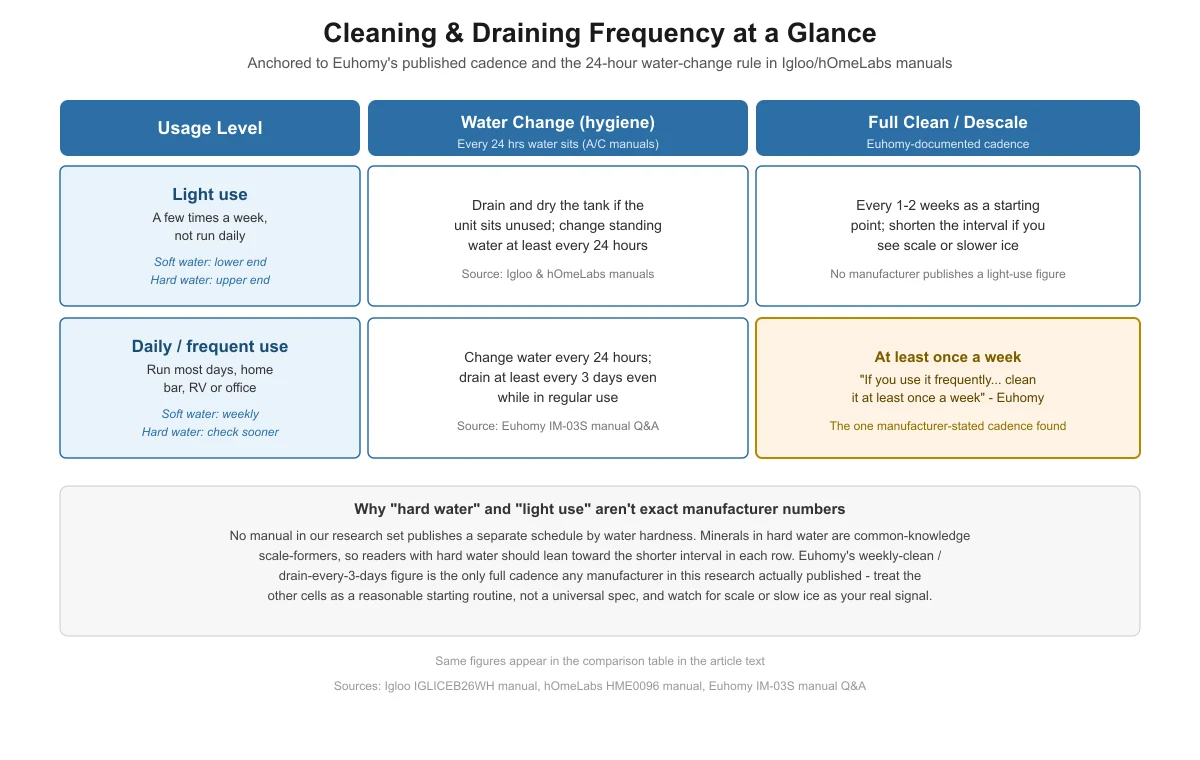
This is where the water you’re using matters more than most guides admit. The table below anchors to the two real numbers in our source set: the 24-hour water-change rule that Igloo and hOmeLabs both publish for hygiene, and Euhomy’s weekly-clean-plus-drain-every-three-days cadence for units in frequent use. No manufacturer publishes a separate schedule broken out by water hardness — that guidance below is general appliance-maintenance reasoning, not a brand-specific spec, so treat visible scale or slower ice as your real signal to clean sooner.
| Usage level | Water change (hygiene) | Full clean / descale | If you have hard water |
|---|---|---|---|
| Light use (a few times a week) | Drain and dry the tank if it sits unused; change standing water at least every 24 hours | Every 1-2 weeks as a starting point — no manufacturer publishes a light-use figure | Lean toward the shorter end; check sooner if cubes look cloudy or shrink |
| Daily / frequent use (home bar, RV, office) | Change water every 24 hours; drain at least every 3 days even during regular use | At least once a week — Euhomy’s own published cadence for frequent use | Check for visible scale on the evaporator fingers before the week is up |
Step by step: how do you clean and descale a portable ice maker?
Unplug the unit first, then work through these steps. They combine the baseline every manual agrees on with the extra vinegar-wipe step from the two brands that mention it.
- Drain all the water. Open the drain plug or cap and empty the reservoir and any water sitting in the base. If your unit has a self-clean or detergent cycle (Euhomy and hOmeLabs both include one), run it now per your manual before you do any hand-cleaning.
- Remove the ice basket and any screens. Rinse the Water Tube Screen or basket under warm running water to clear loose scale and debris.
- Wipe the interior with warm water and mild detergent. This is the step every manual we reviewed agrees on. Use a soft cloth, not an abrasive scrubber, on the tank, basket, and visible interior surfaces.
- Optional: wipe with a vinegar-dampened cloth. If you want extra descaling help on the interior, dampen (don’t soak) a cloth with plain white vinegar and wipe the surfaces the detergent step covered. Avoid wiping the evaporator fingers directly — more than one manual warns against touching that part.
- Rinse twice with clean water. Wipe down with a clean, damp cloth, then rinse again before you refill the tank. This clears any cleaning residue and vinegar smell before the next batch of ice touches drinks or food.
- Refill and run one plain-water cycle before using the ice. This flushes out any trace of cleaning solution from the lines.
What’s different about descaling versus the self-clean cycle?
Some portable ice makers, including the hOmeLabs HME0096 and Euhomy IM-03S, include a self-clean or detergent cycle you trigger with a button combination. That cycle flushes detergent and water through the internal tubing and pump — the parts you can’t reach by hand — then drains. It’s a real, manufacturer-documented step, but it’s not a substitute for wiping the basket, reservoir, and visible interior, which the cycle doesn’t touch. Think of the self-clean cycle as covering the plumbing, and the hand-wipe steps above as covering everything your ice actually sits in or against.
When should you suspect mold instead of mineral scale?
Mineral scale from hard water is typically white, off-white, or cloudy, with a hard or chalky texture that flakes rather than smears, and it shows up on the evaporator fingers, water tray, or tank walls. If what you’re seeing is black, dark green, gray, or pink, and it’s fuzzy or slimy rather than crusty — especially around a rubber gasket, the bin’s lid seal, or anywhere standing water collects — that’s a different problem with a different fix. Our guide to preventing and removing mold in a portable ice maker covers that identification and routine in detail, including why simply descaling won’t solve it.
Could skipping cleaning cause other problems?
Yes — and the connection runs in a direction worth knowing. Scale buildup that restricts water flow to the evaporator fingers is a plausible contributor to small or hollow ice cubes, because a partially blocked water path can mean the ice mold doesn’t fill completely before harvest. It can also, over time, interfere with drain plugs or valves closing fully, which is one reason persistent leaks sometimes trace back to a unit that hasn’t been descaled on schedule. If your unit is already showing those symptoms, see our troubleshooting guide for a portable ice maker that isn’t making ice or our leak causes and fixes guide alongside the cleaning routine here.
Before you choose a unit: does cleaning difficulty vary by model?
It does — tank size, whether a self-clean cycle exists, and drain type (a simple plug versus a plug-plus-removable-tube setup like Euhomy’s) all affect how easy ongoing maintenance is. If you’re still deciding which portable ice maker to buy, our buying guide walks through those differences by use case before you commit to one.
Frequently asked questions
Can I just use vinegar straight, undiluted, to clean my portable ice maker?
None of the manufacturer manuals in our research describe an undiluted vinegar soak. The two brands that mention vinegar at all (Euhomy and the Igloo ICE108 manual) describe wiping the interior with a cloth dampened in vinegar, not pouring vinegar into the tank. Stick to a damp-cloth wipe rather than a concentrated soak, and rinse thoroughly afterward.
How do I know if my water is “hard” for scheduling purposes?
If you notice white, chalky buildup on faucets, showerheads, or kettles in your home, you likely have hard water, and the same minerals will build up faster inside your ice maker. No manufacturer in this research gives a specific water-hardness threshold for ice makers, so treat visible scale or a slower harvest cycle as your practical signal to clean sooner rather than waiting for a fixed date.
Is it safe to run the self-clean cycle with vinegar instead of detergent?
The manuals that include a self-clean cycle (hOmeLabs and Euhomy) describe it as a detergent-based cycle, not a vinegar cycle. We did not find manufacturer instructions for substituting vinegar into that automated cycle, so follow the detergent method your manual describes for the cycle itself, and reserve the vinegar-dampened-cloth method for the hand-wipe step.
Why does my ice taste or smell like plastic or chemicals after cleaning?
This usually means cleaning solution wasn’t fully rinsed out before the next ice batch. Rinse the interior with clean water at least twice after any detergent or vinegar step, and run one full cycle with plain water before using the ice, which flushes residue out of the internal lines.
Does descaling fix slow ice production too?
It can help if scale is restricting water flow to the evaporator fingers, which is a plausible contributor to a slower or incomplete harvest cycle. But slow ice production has several other possible causes — ambient or water temperature out of range, a low reservoir, or a refrigerant issue — so if descaling doesn’t resolve it, work through our not-making-ice troubleshooting guide next.
Sources
- Igloo IGLICEB26WH Owner’s Manual, distributed by Nostalgia Products LLC — read November 2026
- Igloo ICE108 Owner’s Manual (OEM manual listed for the Frigidaire EFIC108-SILVER countertop ice maker) — read November 2026
- hOmeLabs HME0096 “Bullet Ice” Portable Ice Maker Manual, hOmeLabs LLC — read November 2026
- Euhomy IM-03S Ice Maker Manual, Euhomy — read November 2026
portableicemakerly.com Editorial Team. Last updated: November 13, 2026.
One thought on “How to Clean and Descale a Portable Ice Maker”