If your portable ice maker won’t make ice, work through four checks in order: power, water level, temperature, and finally the sealed cooling system. Most problems are solved in the first three steps. If the unit has power, has water, and is within its temperature range but still makes no ice, every manufacturer manual we checked points to the same remaining cause: a refrigerant leak or blocked line that needs a technician, not a DIY fix. For help picking the right unit in the first place, see our portable ice maker buying guide.
Key takeaways
- This diagnostic order comes directly from the troubleshooting tables in four manufacturer manuals (Igloo, an Igloo/Frigidaire-OEM unit, hOmeLabs, and Euhomy), which agree closely on the likely causes and the order to check them in.
- A cycle that runs normally but leaves the basket empty is almost always a temperature problem, not a broken machine — though the exact safe range differs by brand.
- If power, water and temperature all check out and there’s still no ice, every sourced manual says the same thing: contact the manufacturer or a qualified technician.
- This guide is specific to portable countertop units. Built-in refrigerator ice makers have different failure points (a water inlet valve, an auger motor) that don’t apply here.
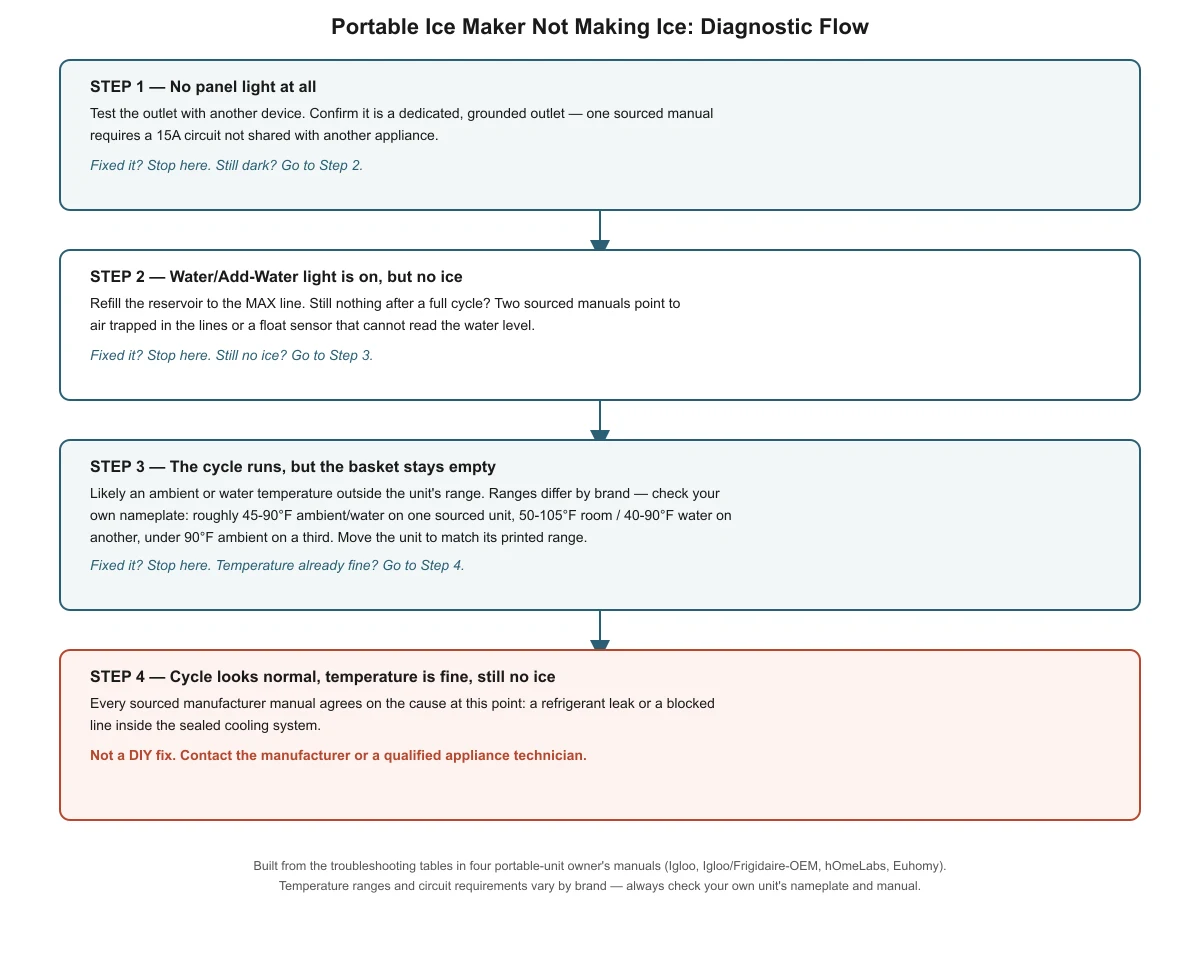
Start here: the 4-step diagnostic flow
Work through these in order. Each step tells you when to stop (you likely found the fix) and when to move to the next one.
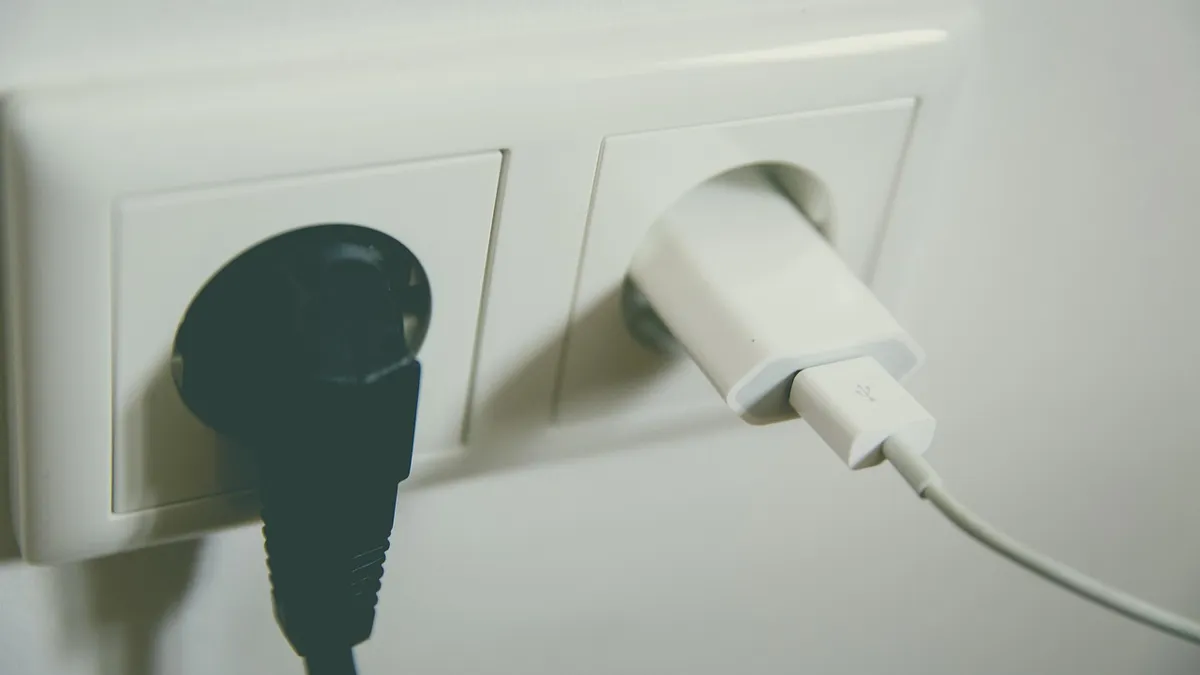
- Step 1 — No panel light at all. Test the outlet with another device. Confirm it’s a dedicated, grounded outlet — one manufacturer’s manual specifically requires a 15A circuit that isn’t shared with another appliance. Fixed it? Stop here. Still dark? Go to Step 2.
- Step 2 — Water/Add-Water light is on, but no ice. Refill the reservoir to the MAX line. Still nothing after a full cycle? Two manufacturer manuals point to air trapped in the lines or a float sensor that can’t read the water level. Fixed it? Stop here. Still no ice? Go to Step 3.
- Step 3 — The cycle runs, but the basket stays empty. This usually means the ambient or water temperature is outside the unit’s range. The exact ranges differ by brand — check your own nameplate: roughly 45–90°F ambient/water on one sourced unit, 50–105°F room temperature with 40–90°F water on another, and under 90°F ambient on a third. Move the unit to match its printed range. Fixed it? Stop here. Temperature already fine? Go to Step 4.
- Step 4 — Cycle looks normal, temperature is fine, still no ice. Every manufacturer manual in our source set agrees on the cause at this point: a refrigerant leak or a blocked line inside the sealed cooling system. This is not a DIY fix. Contact the manufacturer or a qualified appliance technician.
Step 1 in more detail: checking power
Before assuming anything is wrong with the ice maker itself, rule out the outlet. Plug a lamp or phone charger into the same outlet to confirm it’s live. One manufacturer manual is specific that the unit needs its own dedicated 15A, 110–115V grounded circuit — not one already carrying a space heater, microwave, or other high-draw appliance. If you’re troubleshooting this for RV or off-grid use, see our portable ice maker RV and camper 12V power guide for how these units draw power when run off an inverter.
Step 2 in more detail: water level and sensing
An “Add Water” or similar indicator light doesn’t always mean the reservoir is literally empty. Refill it fully to the MAX line first — overfilling is its own problem, covered in our guide to portable ice maker leaks, but underfilling is the more common trigger for this light. If a full reservoir still produces the same warning after a complete cycle, two of the manuals we reviewed separately point to air trapped in the water lines or a float sensor that can’t accurately read the water level — both are reasons the unit “thinks” it’s empty when it isn’t.

Step 3 in more detail: why temperature stops the cycle
Portable ice makers are more temperature-sensitive than a built-in freezer appliance, because they’re small, fan-cooled, and sit out in room air instead of an insulated cabinet. If the room is too hot, too cold, or the water itself is out of range, the compressor can run through a full cycle without producing solid ice, and the basket stays empty even though the machine “sounds” like it’s working.
Don’t assume one number applies to your model. The three manuals that specify a range each give a different one — a few degrees either way on your thermostat or tap water can be the entire difference between a working cycle and an empty basket.
Step 4 in more detail: when it’s not a DIY fix
If you’ve confirmed power, refilled and checked the water sensor, and verified the room and water temperature are both within range — and the unit still won’t make ice despite a cycle that sounds and looks normal — stop troubleshooting on your own. Every manufacturer manual we reviewed treats this combination (normal cycle, correct conditions, no ice) as a sign of a refrigerant leak or a blocked line in the sealed system. That’s a repair that needs the manufacturer’s service line or a qualified appliance technician; attempting to open the sealed refrigerant system yourself can make the unit unrepairable and is not something any of these manuals instruct an owner to do.
Is this different from a built-in refrigerator ice maker not working?
Yes, and it’s worth being clear about the difference before you go searching for more help. A lot of what comes up when you search “ice maker not making ice” is written for the ice maker built into a refrigerator or freezer door — those have a water inlet solenoid valve, a dedicated ice mold with a harvest motor, and sometimes a separate control board, none of which exist in a small countertop unit. The four steps above are built specifically from portable countertop unit manuals, not fridge documentation, so they skip causes (like a frozen fridge water line) that don’t apply to your machine.
How to stop the same problem from coming back
Once you’re back up and running, a few maintenance habits prevent most of these problems from recurring. Scale buildup can restrict water flow the same way a low reservoir does, so keep up with cleaning and descaling on a schedule that matches your water hardness. And if you’ve been chasing a water-level warning that turns out to be an actual leak rather than a sensor issue, check our portable ice maker leaking water guide for the four most common causes. If the cycle finishes but the cubes themselves look wrong — small, thin, or hollow — that’s a separate issue covered in our guide to small or hollow ice cubes.
Frequently asked questions
My portable ice maker’s light is on, but it’s not making any noise at all. What does that mean?
That pattern usually points back to Step 1 — a panel light can stay lit from a low-draw indicator circuit even if the compressor itself isn’t getting power or has failed to start. Confirm the outlet is live and try unplugging the unit for a minute before plugging it back in; if it’s still silent, that’s a sign to contact the manufacturer rather than keep testing it yourself.
Can cold weather stop a portable ice maker from working?
Yes. Several manufacturer manuals set a minimum ambient or water temperature, not just a maximum — one specifies water as cold as 40°F can already be too cold for a normal cycle. If you’re running the unit somewhere unheated, like a garage or a cold RV in winter, that’s worth checking before assuming it’s broken.
Does unplugging and resetting a portable ice maker actually fix anything?
Sometimes, especially for Step 2-type sensor confusion. A water-level sensor or float that’s temporarily misreading the reservoir can reset itself after the unit is unplugged for a minute or two. It won’t fix a Step 4 refrigerant or blockage problem, so if the issue returns right away, don’t keep resetting it repeatedly.
Why does my ice maker say “Ice Full” when the basket is empty?
One manufacturer’s troubleshooting table lists “Ice Full” together with “Add Water” as a combined signal, usually caused by a brief power surge, air in the lines, or a float sensor that can’t detect the water level correctly — the same causes covered in Step 2 above, just a different indicator light for it.
Sources
- Igloo IGLICEB26WH Automatic Ice Maker owner’s manual, distributed by Nostalgia Products LLC — manufacturer manual (PDF).
- Igloo ICE108 owner’s manual (distributed with a Frigidaire-branded countertop unit; OEM/white-label manual) — manufacturer manual (PDF).
- hOmeLabs HME0096 “Bullet Ice” portable ice maker manual, hOmeLabs LLC — manufacturer manual (PDF).
- Euhomy IM-03S ice maker manual, Euhomy — manufacturer manual (PDF).
portableicemakerly.com Editorial Team. Last updated: November 13, 2026.

One thought on “Portable Ice Maker Not Making Ice: Troubleshooting Guide”