
The right portable ice maker depends on where it will live and how much ice you need at once, not on which model has the highest lb/day number on the box. Match capacity, ice type, drain style, noise tolerance and footprint to your actual use case — kitchen counter, home bar, office desk or RV — using the decision table below before you compare individual models.
Key takeaways
- Four manufacturer manuals we checked (Igloo, an Igloo/Frigidaire-OEM unit, hOmeLabs, and Euhomy) plus GE’s Opal specs show portable units running anywhere from about 120W to roughly 360W. “Biggest” and “best for you” are not the same question.
- Nugget ice, the kind GE’s Profile Opal makes, uses an auger-extrusion mechanism. That’s mechanically different from the evaporator-finger machines that make standard bullet or cube ice in the other units we checked.
- Every manual in our source set ships the unit with a drain plug or cap only. None includes a continuously plumbed drain hose, which matters for where you can put the unit.
- None of the manufacturers in our source set publish a decibel rating for their units. Treat any “ultra-quiet” marketing claim with that gap in mind.
- Use the table below to match capacity, ice type, drain type, noise expectations and footprint to your real use case first, then shop models within that lane.
What actually determines which portable ice maker you need?
Five things decide whether a portable ice maker will work for your situation: how much ice you’ll use in a day, which ice texture you actually want, how you’ll get rid of the leftover water, how much noise you can live with, and how much counter or cabin space you have.
Most buying guides stop at specs — lb/day, wattage, dimensions — without connecting those numbers to what you’re actually going to do with the machine. The table below ties four real use cases to the numbers that matter for each one, based on the owner’s manuals for four named units plus GE’s published Opal specs.
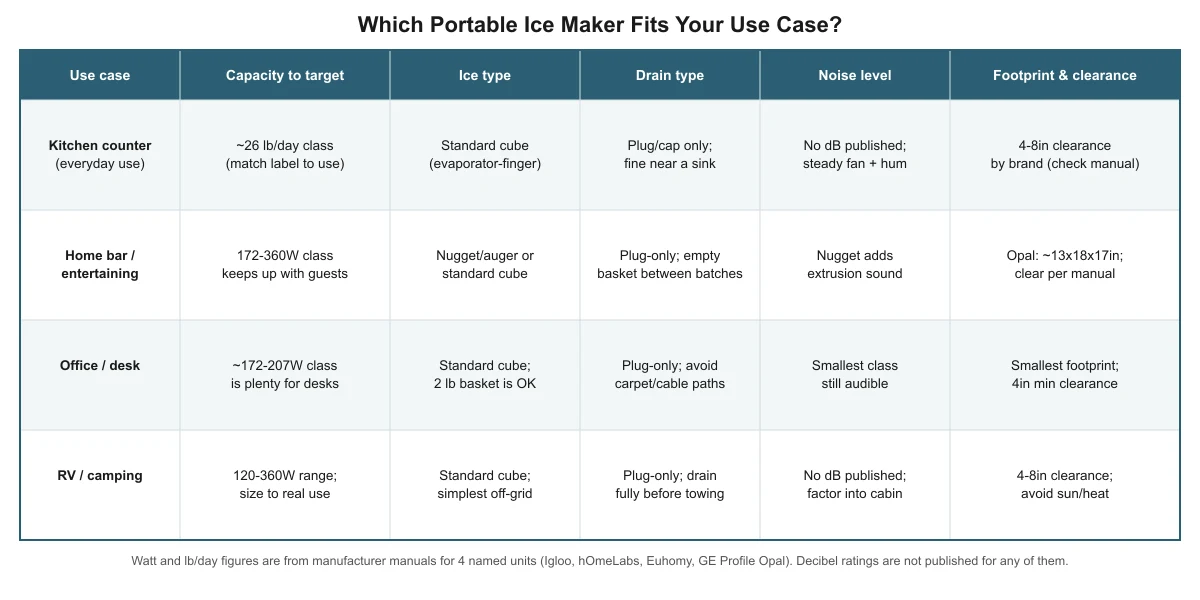
Decision table: match a portable ice maker to your use case
This table applies the same data shown in the chart below it. Use it to narrow down the category of machine you need before comparing specific models.
| Use case | Capacity to target | Ice type | Drain type | Noise level | Footprint & clearance |
|---|---|---|---|---|---|
| Kitchen counter (everyday use) | Our sourced manuals show standard units running about 26 lb of ice per day (Igloo IGLICEB26WH and the Igloo/Frigidaire-OEM unit); check your own model’s label, since this varies by brand. | Standard bullet/cube ice made on an evaporator-finger mechanism — the typical setup in all four sourced manuals. | A drain plug or cap is standard across our sourced brands; fine to use near a kitchen sink. | No sourced manufacturer publishes a decibel rating; expect a steady fan and compressor hum while it cycles. | Clearance requirements vary by brand, from 4 inches (Igloo) to 8 inches (the Igloo/Frigidaire-OEM unit) on all sides — check your unit’s manual. |
| Home bar / entertaining | Higher-draw units in our source set (hOmeLabs at 172–207W, Euhomy at about 360W) can keep up with steady guest use better than the lowest-draw class. | Nugget/auger ice (the mechanism GE’s Profile Opal uses) if chewable cocktail ice matters to you, or a standard cube unit. | A drain plug works fine near a bar sink; plan to empty the basket between batches if there’s no drain close by. | A nugget/auger machine adds grinding and extrusion sound on top of ordinary compressor cycling. | GE’s Opal lists a footprint of roughly 13.4 by 17.5 by 16.5 inches; leave the clearance its manual specifies. |
| Office / desk | The lower-draw class in our source set (hOmeLabs, about 172–207W) is plenty for occasional desk use; skip the highest-output unit. | Standard cube ice; a smaller basket, like the Igloo unit’s 2-pound basket, is enough for personal use. | A drain plug is standard; place the unit where a missed drain won’t reach carpet or cables. | Pick the smallest class available; even then, expect audible cycling at a desk. | Prioritize the smallest footprint you can find, and the shortest listed clearance (4 inches minimum per the Igloo manual). |
| RV / camping | Size to your realistic daily ice use, not the highest-rated number; running draw spans roughly 120–360W across the four named units in our source set. | Standard cube ice is the simplest mechanism to power and maintain off-grid. | A drain plug/cap is standard on portable units; fully drain the reservoir before towing, as every sourced manual instructs. | No sourced manufacturer publishes a decibel rating; factor fan and compressor noise into a small cabin. | Keep the brand-listed clearance (4 to 8 inches across our sources) and avoid direct sunlight or nearby heat sources, as all four manuals warn. |
How much ice capacity do you actually need?
Match the rated output to how you’ll actually use the machine, not to the biggest number you can find. In our source set, the capacity range runs from a lower-draw class (hOmeLabs, pulling about 1.5–1.8A, roughly 172–207W) up to a notably higher-draw unit (Euhomy, at 3.0A, about 360W) and the two Igloo-manual units rated around 26 lb of ice per day. That’s a real spread between brands — the research brief for this site is explicit that you shouldn’t assume one wattage figure applies to the whole category.
If you’re the only one using it for drinks through the day, the lower-draw class is usually enough. If you’re regularly filling a cooler or serving guests, size up toward the higher-draw or higher-rated units.
Does ice type matter: cube, bullet, or nugget?
It matters more than most buying guides suggest. The four portable units in our manual review all use the same basic mechanism: water is pumped into a tray below rod-shaped evaporator fingers, and ice freezes onto the rods in a fast cycle. That produces what’s usually called bullet or cube ice.
GE’s Profile Opal works differently. It’s an auger-extrusion nugget ice maker — a mechanically distinct system that compacts and extrudes soft, chewable ice rather than freezing it onto fingers. If the texture of nugget ice matters for how you drink your cocktails or iced coffee, that’s a different machine category, not just a different setting. For a full side-by-side on melt rate, texture and maintenance, see our comparison of nugget, clear, and cube ice makers.

One honest correction worth making here: some sites market “clear ice” countertop machines. Genuine clear ice requires a slow, directional freeze — the method used for the clear ice spheres and blocks you see at cocktail bars — which is a fundamentally slower process than any fast-cycle countertop unit in our source set uses. Filtered or distilled water can make cube ice look clearer, but it does not produce true clear ice.
Drain plug or drain hose: does it matter where you’ll put it?
Yes, more than it looks on a spec sheet. Three different brands in our manual review — covering four separate product lines — ship with a manual drain plug or cap only; none has a continuously plumbed hose running to a sink. One brand (Euhomy) includes a removable drain tube, but it’s used during the self-cleaning cycle, not as an always-connected line.
That matters for placement: if you’re planning to tuck the unit somewhere without easy access to lift and tip it for draining, you’ll want to understand exactly what “drain” means for the model you’re considering. See our full comparison of drain hose vs. manual drain on a portable ice maker before you buy, especially if placement flexibility matters to you.
What should you check before buying one for an RV or camper?
Check the power math before the ice-making specs. Every unit in our manual review is a 115–120V AC appliance — none runs natively on 12V — so running one off a battery or solar setup means sizing an inverter for both the continuous running watts and the compressor’s brief startup surge. Our four named units span roughly 120–360W running draw, and that range plus the inverter and clearance math is laid out in full in our portable ice maker RV and camper 12V power guide.

How loud is a portable ice maker?
We can’t give you a number — and you should be skeptical of any site that gives you one without naming a specific model and its own spec sheet. None of the four manufacturer manuals in our source set, nor GE’s published Opal materials, lists a decibel rating. What all of them do agree on is that the unit runs its fan and compressor continuously while cycling, so expect audible background noise rather than silence, regardless of what a “quiet” marketing claim implies.
What does owning one actually involve day to day?
Buying the right size and type solves half the problem. The other half is upkeep, and it’s where most portable-unit owners get surprised. A few things to plan for before you buy:
- It won’t always make ice on the first try. See our portable ice maker not making ice troubleshooting guide for the exact order to check things in.
- Finished ice melts faster than freezer ice. These aren’t freezers — see why portable ice maker ice melts fast for what’s normal versus an actual fault.
- Cubes can come out small or hollow, especially as a unit ages or the reservoir runs low. Our guide to small or hollow ice cubes covers the portable-specific causes.
- It needs regular cleaning, not just rinsing. See how to clean and descale a portable ice maker for a schedule based on your water hardness and use.
- Standing water can grow mold if you let it sit. Our mold and mildew prevention guide covers the drain-and-dry routine every manufacturer recommends.
- Leaks usually trace to one of four causes. See portable ice maker leaking water: causes and fixes if you find water where it shouldn’t be.
Frequently asked questions
Do portable ice makers need a water line hookup?
No. Every unit in our manual review is a stand-alone machine: you fill the reservoir by hand, and it does not connect to a household water line. That’s part of what makes them portable in the first place, but it also means you’re responsible for refilling and changing the water yourself.
Can a portable ice maker run on battery or solar power alone?
Only with an inverter. These are 115–120V AC appliances, not 12V-native devices, so a battery or solar setup needs to convert power through an inverter sized for the unit’s running watts and startup surge. See our RV and camper power guide for the full sizing approach.
How long does it take to get the first batch of ice?
Based on two manufacturer manuals in our source set, roughly 7–15 minutes for the first cycle, with the compressor idling for a few minutes on startup before ice-making actually begins. Later cycles are typically faster once the unit has cooled down.
Is a higher lb/day rating always the better choice?
Not automatically. A higher-rated unit usually means a higher running wattage and sometimes a larger footprint, and it doesn’t help if your actual daily use is modest. Match the capacity column in the table above to your real use case rather than buying the highest number you can find.
What’s the real difference between nugget ice and regular ice maker ice?
Nugget ice, like GE’s Profile Opal makes, comes from an auger-extrusion mechanism that compacts soft, chewable ice. Standard bullet or cube ice, made by the other units in our source set, freezes water onto evaporator fingers in a faster cycle. See our full nugget vs. clear vs. cube ice comparison for melt rate and maintenance differences.
Sources
- Igloo IGLICEB26WH Automatic Ice Maker owner’s manual, distributed by Nostalgia Products LLC — manufacturer manual (PDF).
- Igloo ICE108 owner’s manual (distributed with a Frigidaire-branded countertop unit; OEM/white-label manual) — manufacturer manual (PDF).
- hOmeLabs HME0096 “Bullet Ice” portable ice maker manual, hOmeLabs LLC — manufacturer manual (PDF).
- Euhomy IM-03S ice maker manual, Euhomy — manufacturer manual (PDF).
- GE Profile Opal 2.0 Nugget Ice Maker manual and specifications, GE — manufacturer manual mirror (PDF).
portableicemakerly.com Editorial Team. Last updated: November 13, 2026.

2 thoughts on “How to Choose a Portable Ice Maker: A Buying Guide”