Most portable countertop ice makers drain through a simple plug or cap you open over a sink, not a permanently connected hose. That’s confirmed across several brands we checked manuals for. A few pricier models are described online as offering a continuous drain hose, but that claim isn’t verified against any manufacturer manual in our research, so check your specific unit’s own manual before counting on it.
Key takeaways
- Three different brand/OEM lines we checked — Igloo’s IGLICEB26WH, the Igloo ICE108 (a white-label manual also used for a rebadged 26 lb/day unit), and hOmeLabs’ HME0096 — all ship with a manual drain plug or cap only. None has a continuous plumbed hose.
- Euhomy’s IM-03S is the one unit in our source set with something extra: a removable drain tube, but it’s used during the cleaning cycle to flush the machine, not as an always-connected line to a sink.
- Claims that certain higher-end brands offer a true continuous drain hose option turned up in general web searches, but we could not verify this against either brand’s own manual, so this article treats it as unconfirmed, not a feature you should assume your unit has.
- A plug-only drain is actually a practical match for RV and camping use, because it never needs a plumbing hookup — you drain into a jug, a sink, or outside whenever it’s convenient.
- Every manual we checked warns not to overfill the reservoir past its MAX line and to keep the unit level — both matter more than which drain type you have for avoiding spills.
How does a portable ice maker actually drain?
On every unit in our research, water sits in a reservoir that feeds the ice-making cycle, and a drain plug or cap at the bottom lets you empty that reservoir when you’re done, before storing the unit, or as part of routine cleaning. Igloo’s IGLICEB26WH manual instructs owners to open the water drain plug and completely drain the water for long-term storage, and to change the reservoir water every 24 hours during regular use. hOmeLabs’ HME0096 manual gives the same 24-hour water-change instruction and tells owners to drain all the water and dry the tank when the unit isn’t in use.
None of that requires a sink hookup. You tip the unit, or use the plug to let water run into a container, then you’re done. It’s manual labor instead of automatic plumbing, which is the whole tradeoff this article is about.
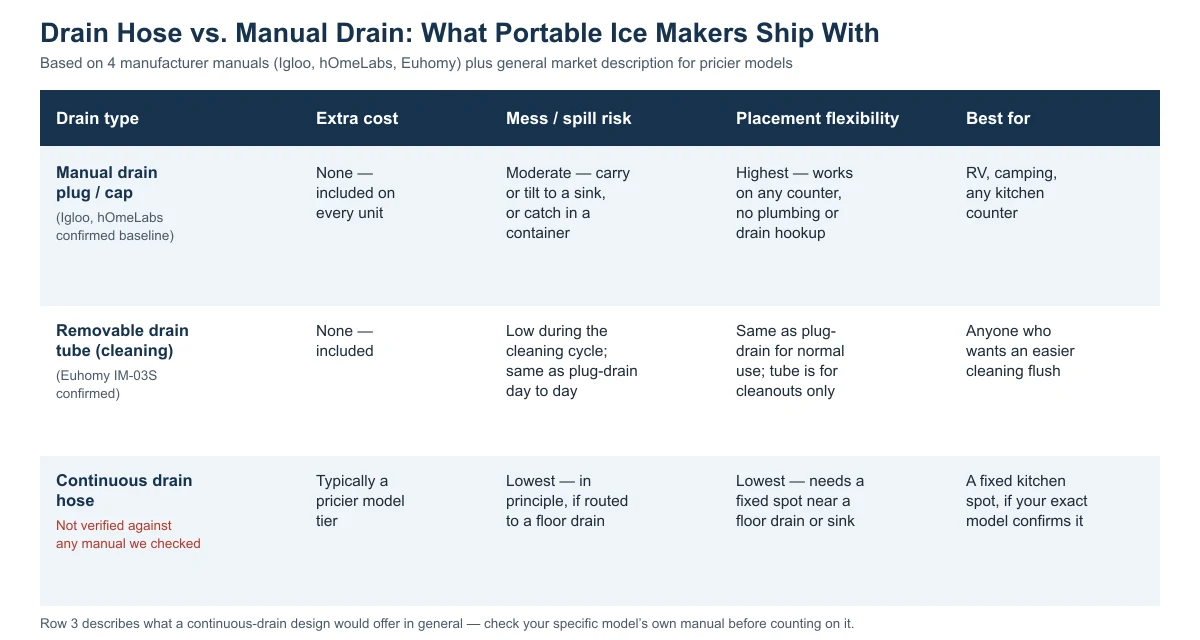
Drain hose vs. manual drain: a side-by-side comparison
The table below compares the three drain approaches we found evidence for, specifically for portable countertop units — not the float-valve or plumbed-in drain systems used on built-in or commercial ice machines, which are a different category entirely.
| Drain type | Extra cost | Mess / spill risk | Placement flexibility | Best for |
|---|---|---|---|---|
| Manual drain plug/cap (confirmed on Igloo and hOmeLabs units) | None — included on every unit we checked | Moderate — you carry or tilt the unit to a sink, or catch water in a container | Highest — works on any flat counter, no plumbing or drain hookup needed | RV, camping, or any kitchen counter without a convenient floor drain |
| Removable drain tube for cleaning (confirmed on Euhomy IM-03S) | None — included | Low during the cleaning cycle itself; day-to-day draining still works like a plug-drain unit | Same as plug-drain units for normal use; the tube is specifically for cleanouts | Anyone who wants an easier flush when descaling or doing a full clean |
| Continuous drain hose (described online for some higher-end models — not verified against a manufacturer manual) | Typically a pricier model tier, if it exists on your unit | Lowest in principle, if the hose is routed to a floor drain | Lowest — needs a fixed spot near a floor drain or utility sink | A fixed kitchen counter near a drain, only if your exact model’s manual confirms the feature |
Is a plug-drain messy to use?
It can be, if you’re not careful, but it’s manageable. The main risk isn’t the drain plug itself — it’s overfilling. Every manual we checked for this article (Igloo’s two models and hOmeLabs’) marks a MAX line on the reservoir and warns against filling past it, because excess water is what actually causes spills and leaks during normal use, not the drain mechanism. If you keep the water level under the MAX line and open the plug over a sink or a wide, shallow container, the process is a quick pour, not a cleanup job.
The other common-sense step: keep the unit level. A tilted unit is more likely to have water find its way somewhere you didn’t intend, whether or not the drain is open.
Does Euhomy’s drain tube count as a drain hose?
Not in the sense most people mean by “drain hose.” Euhomy’s IM-03S manual includes a removable drain tube as part of its self-clean process: you run a 30-minute cleaning cycle, then use the tube to help flush water out through the bottom cap. It’s a genuinely useful feature for cleanouts — easier than tipping the whole unit — but it’s not a permanently connected line running to a sink. For day-to-day draining between uses, the IM-03S still relies on the same basic plug-drain approach as the other units in our research.
Do any portable ice makers actually have a continuous drain hose?
Possibly, but we can’t confirm it. In researching this article, general web searches turned up claims that a couple of higher-end brand names offer a side- or rear-mounted continuous drain hose option on some models. We did not independently verify this against either brand’s own manual, so we’re not naming them here as confirmed, and you shouldn’t take “some higher-end models are described online as offering this” as proof your specific unit has it. If a continuous drain hose matters to your buying decision, the only reliable way to confirm it is to check that exact model’s own manual or spec sheet before you buy — not a general product description or a review site.
What we can say confidently is the baseline: across the Igloo and hOmeLabs manuals in our research, a manual drain plug or cap is what actually ships in the box.
Which drain type is better for an RV or camper?
The plug-only design that’s standard on the units we checked is actually a good fit for RV and camping use, for a straightforward reason: it doesn’t require plumbing into anything. You can drain into a jug, a camp sink, or outside the rig, whenever it’s convenient, rather than needing a fixed drain hookup near where the unit sits. A continuous drain hose would need a dedicated low point to drain to, which is a harder requirement to meet in a moving vehicle than on a stationary kitchen counter.
If you’re specifically planning to run a portable ice maker in an RV, the bigger practical question usually isn’t the drain — it’s power. These are 120V AC appliances, not 12V devices, so running one off a battery bank means sizing an inverter correctly. Our guide to portable ice maker power needs for an RV walks through the actual running-current numbers from four manufacturer manuals and what that means for inverter sizing.
Which drain type is better for a fixed kitchen counter?
On a stationary kitchen counter, either a plug-drain or a drain tube works fine, since you’re not moving the unit between uses. The only scenario where a true continuous drain hose would offer a real advantage is if your counter is already next to a floor drain or a utility sink and you want to skip manual draining entirely. For most kitchen setups, the manual plug is a non-issue: you drain it into the sink it’s sitting next to, on whatever schedule your unit’s manual recommends for water changes and cleaning.
How should you choose based on where you’ll use it?
Start with where the unit will actually live. If it’s moving between a counter, a car, and a campsite, a plug-drain design is the practical choice — which, per our research, describes the Igloo and hOmeLabs units checked here, and most portable units generally. If it’s staying in one fixed spot next to a sink and you specifically want to avoid manual draining, a continuous drain hose would be the feature to look for, but confirm it directly in that model’s manual rather than assuming it from a product listing. For a full walkthrough of what else to match to your use case — capacity, ice type, noise, and footprint — see our portable ice maker buying guide.
Frequently asked questions
Can I leave the drain plug open all the time instead of draining manually?
No. The drain plug needs to stay closed and sealed during normal operation, since the reservoir has to hold water for the ice-making cycle. It’s only opened when you’re intentionally draining the unit — after use, before storage, or during a water change. Leaving it loose or open during operation is a leak risk, not a convenience feature.
Do I need to drain a portable ice maker every day?
Manufacturer guidance varies slightly by brand. Igloo and hOmeLabs manuals both instruct changing the reservoir water every 24 hours during regular use, and draining the tank completely if the unit won’t be used for a while. Check your own unit’s manual for its specific hygiene interval rather than assuming one schedule fits every brand.
Will a drain hose make my ice maker easier to clean?
A dedicated drain tube, like the one on the Euhomy IM-03S, does make the cleaning cycle easier by giving you a controlled way to flush water out. But cleaning the interior, basket, and reservoir by hand is still a separate step on every unit we researched — no drain mechanism, hose or plug, replaces that.
Why don’t more portable ice makers have a continuous drain hose?
We don’t have a manufacturer-stated reason, but the practical explanation is straightforward: these are meant to be portable, countertop appliances you can move between a kitchen, an office, or a camper. A fixed drain line works against that portability, which may be why the manuals we reviewed all default to a simple removable plug instead.
portableicemakerly.com Editorial Team. Last updated: November 13, 2026.
Sources
- Igloo IGLICEB26WH Automatic Ice Maker owner’s manual, Nostalgia Products LLC — manual PDF
- Igloo ICE108 owner’s manual (white-label manual for a rebadged 26 lb/day countertop unit) — manual PDF
- hOmeLabs HME0096 “Bullet Ice” portable ice maker manual, hOmeLabs LLC — manual PDF
- Euhomy IM-03S ice maker manual, Euhomy — manual PDF