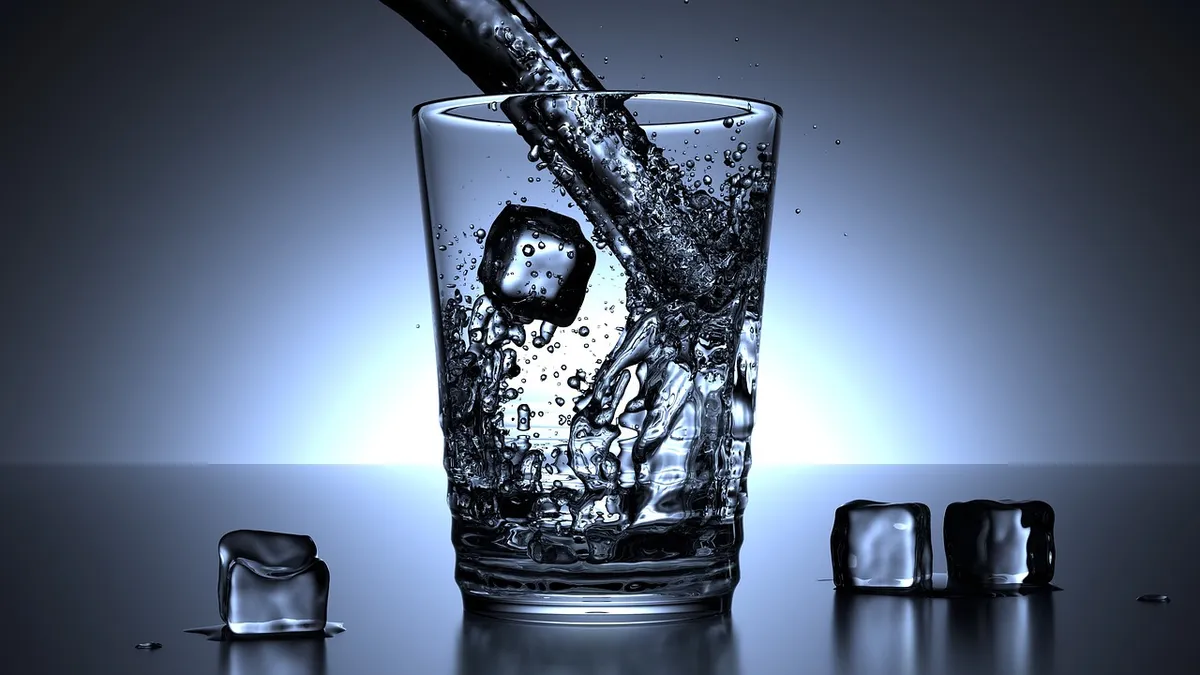
Nugget ice is soft, chewable, and made by an auger that compresses and extrudes it; cube (bullet) ice is dense and hollow-cored, made by freezing water onto fast-cycling evaporator fingers. Neither is true “clear ice” — that requires slow, directional freezing that no fast-cycle portable countertop machine actually does.
Key takeaways
- Nugget ice (the type GE’s Profile Opal makes) comes from an auger-extrusion mechanism: soft, porous, and chewable.
- Standard portable “cube” or “bullet” ice comes from an evaporator-finger mechanism: water freezes onto rod-shaped probes in a fast 7-15 minute cycle, producing a denser, hollow-cored cube.
- “Clear ice countertop maker” is not a verified product category for fast-cycle portable units — genuine clear ice needs slow, directional freezing, a different and much slower process.
- If a portable unit’s cubes look clearer, that is almost always from using filtered or distilled water, not from how the ice was frozen.
- Running power, melt speed, and cleaning routine all differ enough between nugget and cube machines to matter for your actual drink habits.
What’s the real difference between nugget ice, cube ice, and “clear ice”?
Nugget and cube ice come from two genuinely different mechanisms, while “clear ice” describes a freezing method, not a third machine type most people can buy on a countertop.
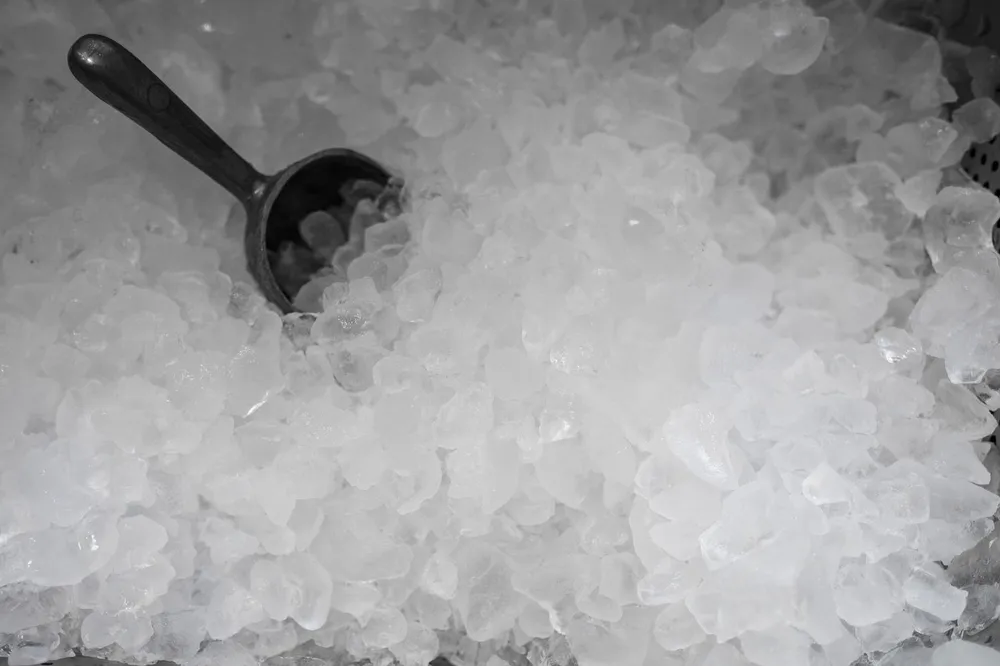
Nugget ice machines, including the GE Profile Opal 2.0, use an auger: a rotating screw that compacts slush into soft, chewable pellets and extrudes them into the bin. It’s a mechanically different process from anything happening in a basic portable ice maker.
Ordinary portable countertop units — the kind sold under names like Igloo, hOmeLabs, and Euhomy — make cube or “bullet” ice a different way. Water is pumped into a tray below a set of rod-shaped evaporator fingers. As refrigerant circulates through the fingers, ice freezes around them in a fast cycle, often producing a first batch in roughly 7 to 15 minutes depending on the brand and size setting. Because the ice forms around a rod, the center stays hollow — that’s simply how the mechanism works, not a sign anything is wrong with the machine.
“Clear ice” is a separate idea entirely: ice that freezes slowly, in one direction, the way a large block or sphere freezes from the top down in a specialized clear-ice mold or a directional-freeze unit used at cocktail bars. That slow, directional process pushes trapped air and minerals to one side as it freezes, leaving the rest genuinely clear. It has nothing to do with whether a machine makes nuggets or cubes — it’s about freeze speed and direction, and none of the fast-cycle portable countertop units in this comparison use that process.
Nugget vs. cube ice: side-by-side comparison
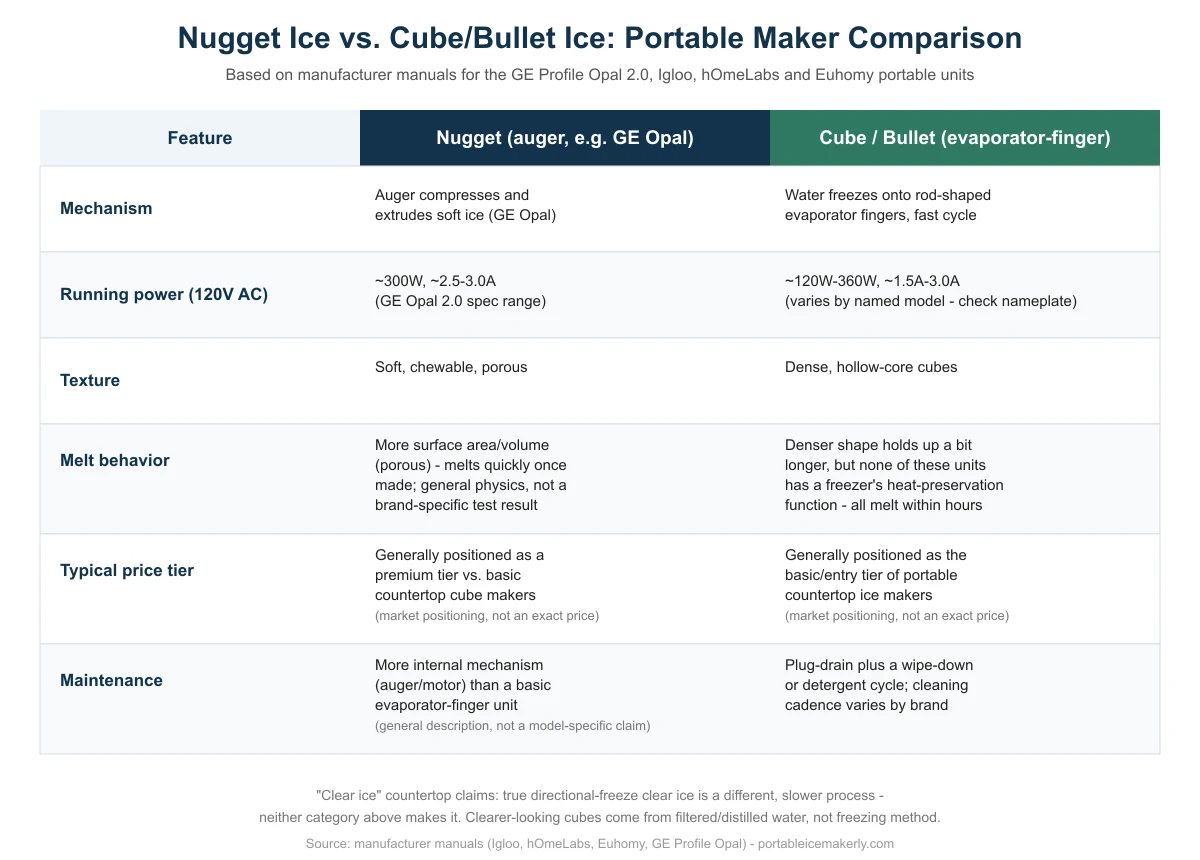
The table below compares the two ice types you can realistically buy on a countertop portable unit today, based on the mechanisms and running-power figures published in manufacturer manuals for the GE Profile Opal 2.0 (nugget) and four evaporator-finger portable units (Igloo, hOmeLabs, and Euhomy models).
| Feature | Nugget ice (auger, e.g. GE Profile Opal) | Cube/bullet ice (evaporator-finger portables) |
|---|---|---|
| Mechanism | Auger compacts and extrudes soft ice | Water freezes onto rod-shaped evaporator fingers |
| Running power (120V AC) | ~300W, about 2.5-3.0A (GE Opal 2.0 spec range) | Roughly 120W-360W, about 1.5A-3.0A — varies by named model; check your unit’s nameplate |
| Texture | Soft, chewable, porous | Dense, hollow-core cubes |
| Melt behavior | More surface area for its volume, so it tends to melt quickly once made | Denser shape holds up a little longer, but none of these units has a freezer’s heat-preservation function — both melt within hours, not days |
| Typical price tier | Generally positioned as a premium tier versus basic countertop cube makers (general market positioning, not an exact price) | Generally the basic/entry tier of portable countertop ice makers (general market positioning, not an exact price) |
| Best drink use case | Chewable ice for sipping drinks, smoothies, snow cones, and drinks where you want ice you can crunch | Cocktails, sodas, and everyday glasses of water where slower melting and a classic cube shape matter more |
| Maintenance difficulty | More internal mechanism (auger and motor) than a basic evaporator-finger unit, in general terms | Plug-drain plus a wipe-down or detergent cleaning cycle; exact cleaning cadence varies by brand — see our cleaning and descaling guide |
Why don’t portable countertop machines make true clear ice?
Because true clear ice is a freezing-speed problem, not a feature any fast-cycle machine is built to solve. Water freezes clear only when it freezes slowly enough, and in a single direction, for dissolved air and minerals to be pushed ahead of the ice front instead of getting trapped inside it. That’s exactly what happens in a slow, directional-freeze block mold — and exactly what does not happen in a 7-to-15-minute countertop cycle.
Some portable-unit manufacturer FAQs address cloudiness directly without claiming to solve it the “clear ice” way. Euhomy’s own FAQ for its IM-03S model attributes cloudy-looking ice to water quality and turbidity, and recommends using filtered or distilled water for clearer-looking results. That’s a real, useful tip — but it is a different thing from true clear ice. Filtered water removes some of the particles that scatter light inside the cube; it does not change the freezing process itself, so the cube still forms around a hollow evaporator finger in a fast cycle, the same as it would with tap water.
If you see a portable countertop unit marketed or reviewed as a “clear ice maker,” treat that description skeptically. It most likely means the unit produces clearer-looking cube ice when you use filtered or distilled water — a real but modest improvement — not genuine directional-freeze clear ice. If true clear ice matters to you (for photography-worthy cocktails, for example), that’s a separate category of slow-freeze molds and dedicated clear-ice equipment, not something any of the fast-cycle portable countertop machines in this comparison are built to do.
Which ice type actually fits your drinks?
Start with how you drink, not which machine looks more advanced.
- You like to chew your ice, drink smoothies, or make snow-cone-style treats: nugget ice is the better fit. Its soft, porous texture is comfortable to bite and it packs well around a straw.
- You mostly drink cocktails, soda, iced coffee, or plain water, and you care about a classic look: cube/bullet ice from a standard evaporator-finger unit is the simpler, usually less expensive choice, and it looks like the ice most people expect in a glass.
- You want ice that looks genuinely clear, like at a cocktail bar: neither category here delivers that. You’d need a dedicated slow-freeze clear-ice mold or machine, which is a different, much slower product entirely.
- You’re setting up a home bar, RV, or office counter and want to compare machines on more than ice type: our portable ice maker buying guide walks through capacity, drain type, noise, and footprint side by side.
Does running power or noise differ much between the two types?
Yes, and it’s worth checking before you buy, especially if you’re powering the unit from a limited circuit or an inverter. Across the manufacturer specs reviewed for this comparison, evaporator-finger cube machines range from about 120W to 360W (roughly 1.5A to 3.0A at 115-120V), while the GE Profile Opal 2.0 nugget machine runs at roughly 300W (about 2.5-3.0A). Both categories are standard 115-120V AC appliances — none of them runs natively on a 12V battery. If you’re planning to run one off-grid or in an RV, see our RV power guide for portable ice makers for how to size an inverter correctly for either type.
None of the manuals reviewed publish a decibel rating for these units, so we can’t give you an exact noise number for either category — both run a compressor and a fan continuously while cycling, and in general, auger mechanisms (nugget machines) have an additional moving part compared with a basic evaporator-finger unit, which can add a bit more running noise, though this varies by model and isn’t something manufacturers quantify in the sources we reviewed.
Frequently asked questions
Is nugget ice healthier or safer to chew than cube ice?
There’s no safety difference tied to the ice type itself — both are made from whatever water you fill the reservoir with. Nugget ice is simply softer and more comfortable to chew because of its porous, compacted texture, while dense cube ice is harder on teeth if you’re someone who chews ice. Neither manufacturer in our research claims a health benefit for either type.
Can I buy a portable countertop machine that makes real clear ice?
Not among the portable countertop units and nugget machines covered in this comparison. True clear ice requires slow, directional freezing, which is a different and much slower process than any fast-cycle countertop machine uses. If a listing calls a fast-cycle countertop unit a “clear ice maker,” expect clearer-looking cube ice from filtered water, not genuinely clear ice.
Why does my portable ice maker’s “clear ice” setting still make cloudy cubes?
Cloudiness usually comes from water quality, not a setting. Euhomy’s own FAQ for its IM-03S model points to water turbidity as the cause of cloudy ice and recommends filtered or distilled water for clearer-looking results. If cubes are still cloudy with filtered water, the machine itself isn’t malfunctioning — that’s simply the limit of what a fast-cycle evaporator-finger machine can do.
Does nugget ice melt faster than cube ice?
Generally yes, because it has more surface area relative to its volume, which is basic physics rather than a manufacturer claim. That said, manufacturer documentation for these portable units is consistent on one point: none of them has a freezer’s heat-preservation function, so both nugget and cube ice melt within hours once made, not days, regardless of type.
Is a nugget ice machine worth the higher price over a basic cube machine?
That depends entirely on whether you actually prefer chewable ice. If you drink mostly cold beverages without chewing the ice, a basic evaporator-finger cube machine does the job at a lower general price tier. If chewable, snow-cone-style ice is something you specifically want, the auger mechanism in a nugget machine is the only way to get that texture at home.
Sources
- GE Profile Opal 2.0 Nugget Ice Maker manual/specifications (manufacturer-hosted PDF mirror via Williams-Sonoma) — auger-extrusion mechanism and running current/wattage range.
- Euhomy IM-03S portable ice maker manual, including manufacturer FAQ — cloudy-ice cause and filtered/distilled water recommendation, running current.
- hOmeLabs HME0096 “Bullet Ice” portable ice maker manual — evaporator-finger mechanism and running current.
- Igloo IGLICEB26WH automatic ice maker owner’s manual — evaporator-finger mechanism and running current.
portableicemakerly.com Editorial Team. Last updated: November 13, 2026.
One thought on “Nugget vs. Clear vs. Cube Ice: Which Maker to Buy”