Last updated: November 16, 2026
Quick Answer: usually no — distilled water is the wrong choice for many portable ice makers because it can be too pure for the machine’s conductive liquid sensor to detect. If your unit uses dissolved ions to read the water level, distilled water can trigger a fill error or keep the machine from starting ice production. In this article about Can You Use Distilled Water in a Portable Ice Maker?, the key issue is sensor conductivity, not ice quality.
Key takeaways
- Distilled water can be so low in dissolved ions that the sensor does not “see” it.
- The problem is usually not the water making bad ice; it is the machine failing to read the tank.
- A portable ice maker that depends on electrical conductivity may need minerals in the water, not zero minerals.
- If the unit shows a water-add error with distilled water, the fix is usually to switch water type, not to force the machine.
- This issue is about sensor design, not about ice quality alone.
What is the short answer on distilled water?
Usually, distilled water is a bad match for a portable ice maker that uses a conductive liquid sensor. The machine depends on electrical conductivity, and distilled water has very few dissolved ions and electrolytes, so the sensor may not register that water is present.
That does not mean distilled water is harmful to the ice maker in the same way a clogged line is harmful. The main issue is detection. If the sensor cannot read the water level, the machine may keep asking for water, refuse to start, or stop mid-cycle.
This is why the answer is not a simple yes or no for every model. A portable ice maker with a float-style or mechanical water-level check may behave differently from one that depends on conductivity. The same jug of distilled water can work in one machine and fail in another.
For many models, the safest reading is narrower than an absolute rule: if the manual says the unit uses a conductive sensor or warns about low-mineral water, distilled water is likely to cause trouble. That is the answer most people need before they pour the first gallon.
Why does distilled water trigger a sensor error?
Distilled water triggers a sensor error because the sensor needs dissolved ions to complete the circuit. Pure water is a poor conductor compared with tap water, and portable ice makers often use that difference to tell whether the reservoir is full.
A conductive liquid sensor does not “measure water” in the abstract. It looks for a path for current. When the water has enough dissolved minerals, the current passes more easily. When the water is distilled, that path can be too weak for the machine’s control board to read reliably. According to the USGS, water with fewer dissolved ions has lower specific conductance, which is why conductivity changes matter so much in a small sensor circuit.
That is why people see messages such as add water, fill, or no water even when the tank is visibly full. The problem is not the water line, the ice mold, or the compressor at first. The control system simply does not get the signal it expects.
This is also why the issue shows up more in small countertop units than in older machines with simpler mechanics. Many portable ice makers are designed around quick sensing, and quick sensing depends on conductivity. A water sample with almost no dissolved solids can fall outside what the machine expects to see.
Which water types compare best?
Because of that sensor trade-off, the best water for the machine is usually the one that gives the sensor enough conductivity without leaving heavy scale behind. Distilled water sits at one end of the range, while mineral-heavy water sits at the other.
Here is the practical comparison:
| Water type | Sensor behavior | Main upside | Main downside |
|---|---|---|---|
| Distilled water | May not register | Low dissolved solids | Can cause add-water errors |
| Tap water | Usually registers well | Easy for the sensor to detect | Can leave mineral scale |
| Demineralized water | May act like distilled water | Lower mineral content than tap water | Can still be too pure for the sensor |
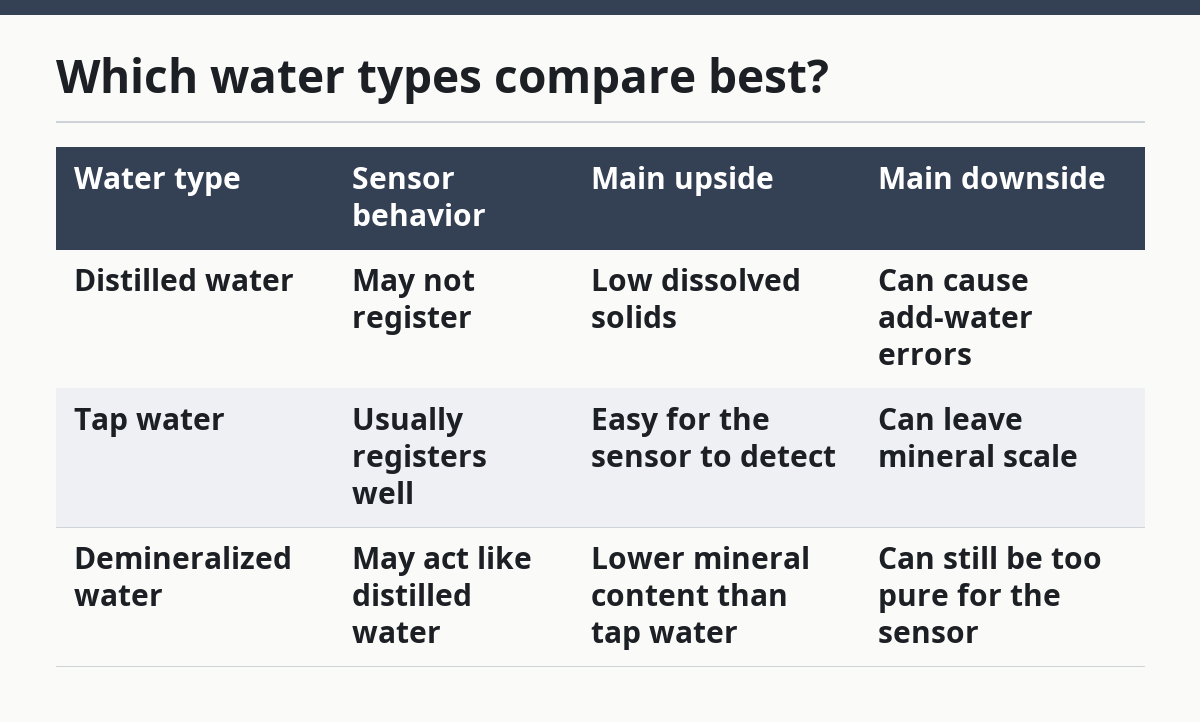
This table is the key trade-off. If the machine is picky, the very water that seems “cleanest” may be the one that causes the most trouble. A demo unit in a store may appear fine with distilled water if it has a different sensor design, but that does not tell you much about your own model.
In particular, the phrase demineralized water ice machine comes up for the same reason. Less mineral content sounds helpful, but there is a point where the water becomes too pure for a conductive liquid sensor to detect. That line is not universal, which is why the manual matters.
How do I check my portable ice maker?
You check your portable ice maker by looking for the sensor type in the manual, then testing with the water the maker was designed to read. If the manual does not name the sensor, the first clue is the error message the unit gives when the reservoir is full.
Use this order:
- Look for terms such as conductive sensor, water level sensor, or add water warning in the manual. That tells you the machine likely depends on conductivity, not just a float.
- Fill the reservoir with the water the manual recommends first, usually plain tap water. Start the machine and watch whether it begins the normal cycle within a few minutes.
- If the unit reads the water correctly with tap water but fails with distilled water, the cause is the low dissolved ions in the distilled water, not a bad pump.
- If the machine still fails with normal water, the problem is probably elsewhere, such as a dirty sensor or another fault that needs service.
Therefore, this is often the quickest way to separate a water issue from a machine issue. It also keeps you from blaming distilled water for a problem it did not create. A portable ice maker that runs normally with tap water but not with distilled water is giving you a clear clue about conductivity.
If you are trying to avoid scale, start with the water the machine accepts and solve buildup another way. The page in the water quality for portable ice makers hub covers the broader choices without turning this topic into a guesswork exercise.
What should I do instead of distilled water?
Since the sensor needs a readable signal, you should use water that the sensor can read, then clean the machine on a regular schedule. For many portable ice makers, that means not choosing distilled water if it causes a sensor fault.
There are two practical paths here. First, use the water the manual expects, often tap water, if the machine’s sensor depends on conductivity. Second, keep the machine clean enough that normal water does not leave heavy deposits on the sensor or in the reservoir.
A lot of people try to solve one problem and create another. They switch to distilled water to reduce mineral spots, then the ice maker stops reading water. Or they stay on hard water, get sensor detection, and later deal with scale. The better fix is to match the water to the machine’s sensing method and handle buildup with cleaning.
This is also where demineralized water can be confusing. It sounds like a middle ground, but if the dissolved ions are too low, the machine may behave almost the same way it does with distilled water.
In other words, “less mineral” is not always “better” for the sensor.
If your goal is clean ice, this page is not the place to chase crystal-clear results. That is a different question. The job here is to keep the machine from failing because the water is too pure for its conductive liquid sensor.
Can distilled water damage an ice machine?
Distilled water usually does not damage the ice machine by itself, but it can cause operational problems. The main risk is a false water reading, not immediate physical damage.
That said, repeated failed starts, forced resets, or constant error cycling can wear on the machine over time. A control board that keeps trying to read a tank it cannot sense may create frustration and repeated restarts, even if the water itself is not corroding parts. The cost is time, not just convenience.
There is one honest limit here: if the unit’s manual says distilled water is acceptable, then the machine was designed with that water in mind. In that case, the risk shifts from “won’t work” to “works as specified.” If the manual does not say that, do not assume the machine will tolerate ultra-low-conductivity water just because the water is clean.
For safety or warranty questions, the manual still wins. If the machine keeps showing an add-water error with the tank full, do not keep forcing cycles for long stretches. The problem is usually the sensor reading, and the fix starts with changing the water type.
When is distilled water the wrong choice?
After those checks, distilled water is the wrong choice when your portable ice maker depends on conductivity to detect water. That is the simplest rule, and it covers many countertop models with conductive liquid sensors.
It is also the wrong choice when the machine already shows an add-water or no-water error with the reservoir full. In that situation, distilled water is not helping and may be the cause. If you already know the unit is sensitive to dissolved ions, switching to distilled water just makes the sensor’s job harder.
This is not a case where “purer” automatically means “better.” Pure water conductivity is too low for some portable ice maker designs. The machine needs a signal, and dissolved ions are part of that signal. A user who wants the same ice from a different water source should focus on the sensor type first, then on water quality.
For a quick rule of thumb, assume distilled water is a poor fit unless the manual says otherwise. That keeps you from chasing a water problem that is really a sensor problem.
Why won’t my ice maker work with distilled water?
Because distilled water may not conduct electricity well enough for the sensor to detect it, your ice maker may not work with distilled water. Many portable units use dissolved ions to sense water presence, so distilled water can look empty to the control board even when the tank is full.
Can distilled water damage an ice machine?
Because the main issue is sensing, distilled water usually does not damage the ice machine directly, but it can make the unit misread the water level. The bigger risk is repeated error cycles, failed starts, and unnecessary troubleshooting. If the manual allows distilled water, follow the manual; if it does not, use a water type the sensor can read.
Meanwhile, the reason this answer changes by model is simple: a portable ice maker with a conductive liquid sensor is not reading “clean water” or “dirty water,” it is reading conductivity. That is why a full reservoir can still look empty to the control board.
Ultimately, the best source for your exact model is still the manual, especially if it names conductive sensing or gives a water-quality warning. If it does, treat that note as more important than a general rule about distilled water.
Drafted with AI; not yet reviewed by a person.