Last updated: November 16, 2026
Quick Answer: 1 safe default—choose a pure sine wave inverter if you are running a portable ice maker on a 12V inverter. Choose modified sine wave only if the maker’s manual explicitly allows it and the machine is small, simple, and not already prone to buzz, heat, or restart problems. The waveform matters because a modified sine wave raises electrical stress, noise, and heat in motors and valves, while pure sine wave behaves much closer to grid power. For waveform background, see Victron Energy’s overview of pure sine wave vs. modified sine wave and Samlex’s inverter guidance.
Key takeaways
- A portable ice maker is not just “a small appliance”; its compressor and valve care about waveform shape.
- Pure sine wave is the safer choice for refrigeration loads because it lowers the chance of overheating windings and odd starts.
- Modified sine wave can run some ice makers, but it is the riskier choice when total harmonic distortion is high.
- The manual matters more than the inverter label. If the maker forbids modified wave power, that warning should be taken seriously.
- If the ice maker already buzzes, hesitates, or runs hot on inverter power, the waveform is a likely suspect.
- For related sizing and runtime questions, see the hub on portable ice maker power use off grid and the guide to 12V inverter sizing.
What is the real difference here?
The real difference is how the inverter feeds the compressor motor and solenoid valve. A pure sine wave inverter makes AC that closely matches utility power, while a modified square wave sends stepped power with much higher total harmonic distortion.
That difference sounds abstract until a small refrigeration compressor tries to start. An ac induction motor prefers a smooth rotating magnetic field. A stepped waveform can make the motor hum louder, start less cleanly, and run hotter than it would on a pure sine wave. In the same system, a solenoid valve may also chatter or draw ugly current pulses if the power waveform is coarse.
For an ice maker, the key problem is heat. Overheating windings are the classic failure mode when a motor is forced to work harder than it should. The compressor may still spin, but the extra electrical stress may shorten life or trigger a weak start, especially if the unit already sits near its limit. A refrigeration appliance on a rough waveform is worth checking with the manufacturer or a qualified technician before regular use. For a general waveform reference, Schneider Electric’s inverter literature also distinguishes cleaner sine output from stepped output.
The phrase “12V inverter” also needs a plain translation. The inverter does not run the ice maker on 12 volts; it takes 12V DC from a battery system and turns it into AC. The waveform quality is what decides whether that AC looks friendly to the compressor or rough enough to cause trouble.
Can a portable ice maker run on modified sine wave?
Yes, some portable ice makers can run on modified sine wave, but that is not the same as being a good match.
This is where many generic answers go wrong. They treat “it powers on” as the finish line. A compressor that starts today on a stepped waveform may still run hotter, buzz louder, or age faster than the same machine on pure sine wave. Harmonic distortion is the issue behind that gap. Higher distortion means more wasted current, more vibration, and more thermal stress inside the motor.
The safe reading is simple: if the manufacturer does not say the appliance is compatible with modified square wave power, assume that compatibility is uncertain. That is especially true for portable ice makers with hermetic refrigeration compressors, because those compressors are not casual loads like a phone charger or an LED lamp. If the manual is silent, treat the setup as unverified and consult the maker or a qualified electrician before relying on it.
Modified sine wave is the weaker choice for anyone who wants long run time, lower noise, and less electrical drama. It can make sense for a backup setup where the ice maker is used only now and then, the inverter is already owned, and the unit is not expensive to replace. It is a poor choice for a daily-use setup, a warm garage, or any system where the battery bank is already under strain.
The honest bottom line is that modified sine wave is a gamble, not a clean “yes.” A good rule of thumb is to favor the cleaner waveform whenever the appliance has a compressor and the owner needs repeatable results.
Why pure sine wave wins for refrigeration compressors
Pure sine wave wins for refrigeration compressors because it gives the motor a cleaner magnetic field and fewer waveform-related surprises.
A portable ice maker usually depends on a small compressor and may also use a solenoid valve during the ice-making cycle. Both devices are happier when the power is smooth. Pure sine wave lowers the chance of current spikes, audible buzz, and heat buildup in the windings. It also gives the start-up behavior that appliance designers usually expect when they size the compressor and control board.
That matters more than the label on the inverter box. Some modified sine wave inverters work fine with simple resistive loads, but a refrigeration compressor is not a toaster. It is an inductive load with moving parts and startup demand. A stepped waveform can confuse that load enough to create trouble without ever throwing a dramatic fault code.
Pure sine wave is also the better match when the ice maker shares power with other sensitive gear. If the same inverter is feeding a battery charger, control board, or small electronics nearby, the cleaner waveform reduces cross-noise and nuisance behavior. The system feels calmer because the electrical edges are smoother. For inverter basics, see Victron’s note on waveforms and Samlex’s inverter sizing pages.
The drawback is obvious: pure sine wave units are usually the more careful, more expensive class of inverter. That said, the extra cost is easier to justify than replacing a compressor that has been cooked slowly by modified wave power. In practice, the price gap is often smaller than the repair risk.
The honest side-by-side
Pure sine wave wins for almost every portable ice maker owner who wants reliability instead of a coin flip.
| Criteria | Pure sine wave | Modified sine wave | Winner for this condition |
|---|---|---|---|
| Compressor startup | Cleaner start, closer to utility power | More start stress and hum risk | Pure sine wave |
| Total harmonic distortion | Lower | Higher | Pure sine wave |
| Risk of overheating windings | Lower | Higher | Pure sine wave |
| Noise and vibration | Usually lower | Often louder | Pure sine wave |
| Solenoid valve behavior | More predictable | Can chatter or sound rough | Pure sine wave |
| Tolerance for uncertain manuals | Better margin | Less margin | Pure sine wave |
| Battery efficiency under load | Usually better for sensitive loads | Can waste power in heat and noise | Pure sine wave |
| Cost pressure | Usually higher upfront burden | Usually lower upfront burden | Modified sine wave |
| Best use case | Daily or frequent ice making | Occasional emergency use only | Pure sine wave |
| Risk tolerance | Low-risk choice | Higher-risk choice | Pure sine wave |
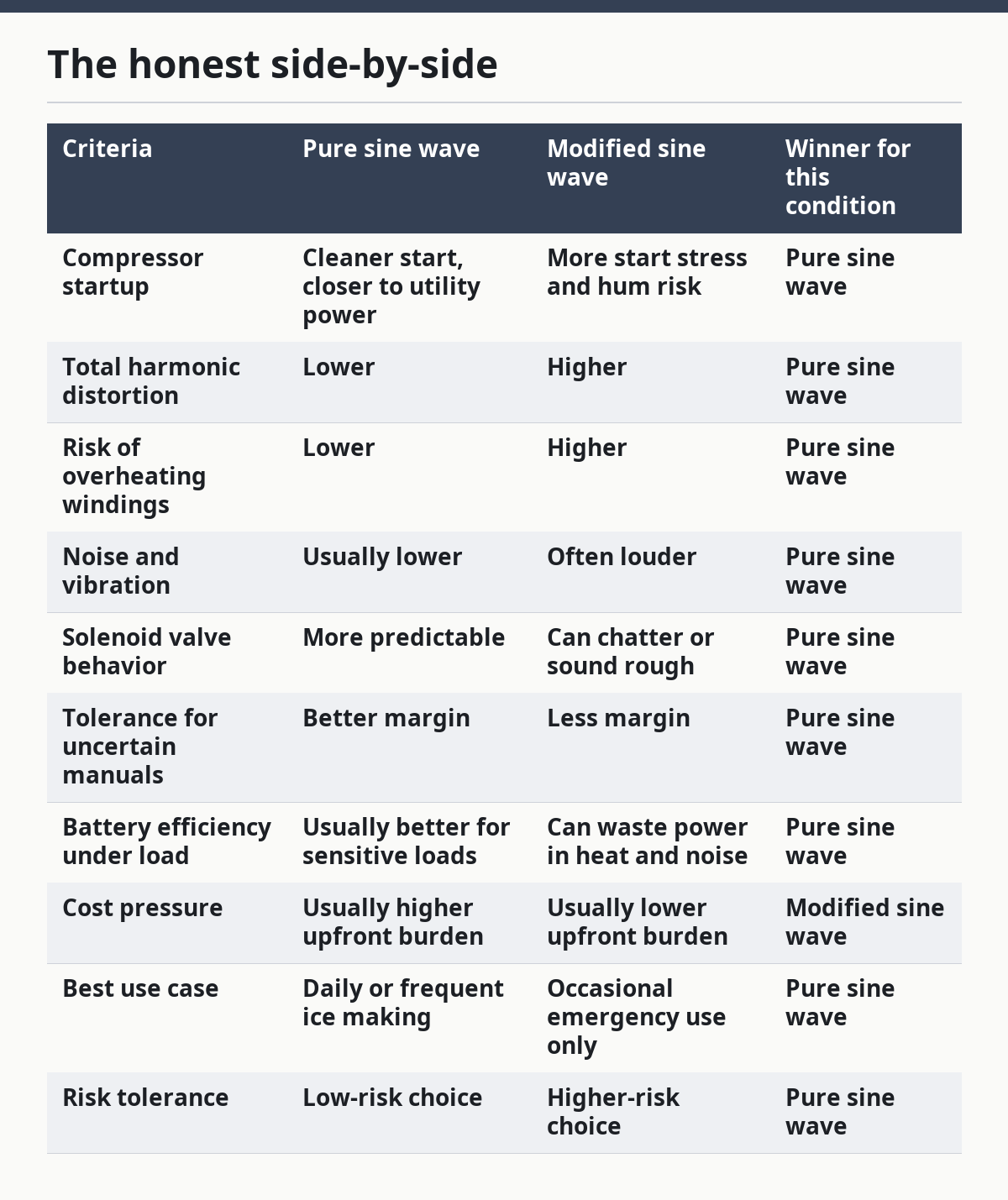
The table makes the pattern plain. Modified sine wave only wins on one narrow point: it can cost less up front. That is a weak win when the load is a compressor-based appliance. The trade-off is still real: more heat, more noise, and less confidence that the compressor is being treated kindly. If the waveform is rough enough, consult the appliance manual or a professional before assuming the setup is acceptable.
The one place where modified sine wave can still make sense is a backup rig that sees light duty and has plenty of inverter headroom. Even there, the owner should expect more noise and accept that the machine may be less comfortable on that power than on a cleaner waveform.
When does the answer flip?
The answer flips only in a few specific cases.
First, if the portable ice maker manual explicitly says it accepts modified square wave power, that changes the risk picture. A maker that was designed with that waveform in mind has at least some tolerance built in. Even then, pure sine wave is still the safer choice, but the “do not use this” warning may no longer apply.
Second, if the machine uses very little power and does not rely on a finicky compressor start, modified sine wave may be acceptable for short, occasional use. That does not make it ideal; it makes it less dangerous than it would be for a more delicate refrigeration load.
Third, if the inverter is already being pushed near its limit, waveform choice becomes even more important. In that case, a small compressor can suffer from low-voltage behavior on top of wave-shape problems. The result is more buzzing, more heat, and a higher chance of nuisance shutdown.
Fourth, if the goal is backup use during outages and the ice maker is a convenience item rather than a daily appliance, the economics shift. An owner may accept the compromise and watch the machine closely. Even so, the trade-off is still real: more heat, more noise, and less confidence that the compressor is being treated kindly.
What should a beginner actually buy?
A beginner should buy pure sine wave unless the ice maker manual clearly says modified wave is acceptable and the use case is light.
That is the cleanest recommendation for anyone comparing a 12V inverter for a portable ice maker. Pure sine wave is the better fit for the compressor, the solenoid valve, and the long-term health of the machine. It also keeps the decision simple: fewer waveform problems, fewer weird starts, fewer questions later.
Choose modified sine wave only if all of these are true at once: the maker tolerates it, the ice maker is not mission-critical, and the owner is willing to accept more heat and sound. That is a narrow lane. It is not the default lane.
Neither choice is wise if the ice maker already shows signs of strain, if the inverter output is unknown, or if the setup is meant to run hard for long stretches. In that case, the better move is to solve the power system first, not force a compressor to tolerate rough AC.
For related off-grid sizing and runtime questions, the broader guide on portable ice maker power use off grid belongs in the hub above this topic, because inverter waveform is only one part of the battery math.
Will a modified sine wave inverter ruin an ice maker?
Not always, but it may shorten compressor life or cause trouble if the waveform is rough enough. A portable ice maker with a hermetic compressor is more vulnerable than a simple appliance because the motor has to start cleanly and stay cool. If the manual warns against modified wave power, take that warning seriously.
Why is my ice maker motor buzzing on inverter?
A buzzing motor on inverter power usually points to waveform stress, low voltage, or both. Modified sine wave can make an ac induction motor hum more because the current is less smooth, and that extra noise often comes with extra heat. If the buzz appears only on inverter power, the waveform is a likely suspect.
What is the plain verdict?
Choose pure sine wave if the ice maker has a compressor, if the goal is regular use, or if the manual is silent on modified wave power. Choose modified sine wave only if the appliance documentation allows it and the setup is a light-duty backup system. Neither is a good choice if the machine already runs hot, buzzes hard, or struggles to start on inverter power.
The reason is simple: portable ice makers are small, but they still contain refrigeration parts that behave like refrigeration parts. Total harmonic distortion is not just a spec sheet number here. It changes how a compressor starts, how hot its windings get, and how long the machine is likely to stay healthy.
Drafted with AI; not yet reviewed by a person.