
Last updated: November 17, 2026
A squeak or grind from a portable ice maker usually means the internal drive motor is forcing the tray, cam shaft, or nylon drive gears against dry plastic or worn parts. If the sound changes when the ice tray moves, food-grade silicone grease may help; if the noise comes from the fan motor bearing or the motor itself, lubrication will not fix it and the part may need replacement.
Key takeaways
- A squeak usually points to friction; a grind usually points to worn teeth, a misaligned cam shaft, or a failing drive motor.
- The safe first fix is cleaning and a light application of food-grade silicone grease on the moving plastic contact points.
- Do not use household oil or heavy grease inside the ice path; those products can attract dirt or contaminate ice-contact parts.
- If the noise comes from the fan motor bearing or the motor housing, lubrication on the tray side will not solve it.
- A loud, steady grind that started suddenly is a sign to stop the machine and inspect the gears before more parts wear out.
What is making the noise?
The noise is usually coming from one of four places: the internal drive motor, the nylon drive gears, the cam shaft, or the fan motor bearing. A portable ice maker uses a small motor to turn the tray or ejector parts, so even a little drag can turn into a squeak or grind.
A squeak is the softer warning. It often means dry plastic rubbing on plastic, or a shaft that has lost its light factory lubricant. A grind is harsher and usually means a tooth is skipping, a gear is chipped, or a shaft is no longer running straight.
The key clue is when the sound happens. If it appears during harvest or tray movement, the problem is usually on the drive side. If it is a constant hum with a scrape, the fan motor bearing or the motor itself may be involved. That distinction matters because grease can help one case and do nothing in the other.
Do not assume every noise means the machine is dying. A countertop ice machine squeal can come from a dry pivot point that only needs cleaning and a small amount of food-grade silicone grease. But if the sound gets louder over a few cycles, or the machine starts to jerk, the damage may already be in the gear teeth.
How do I tell squeaking from grinding?
A squeak usually means friction, while grinding usually means wear. That difference matters because friction is often fixable with cleaning and lubricant, but grinding often means a part is already damaged.
Use this quick comparison before you open the case:
| Sound | What it usually means | What to check first | What it usually costs you if ignored |
|---|---|---|---|
| Squeak | Dry pivot, cam shaft, or tray contact | Food-safe lubricant on moving plastic points | More wear, higher strain on the drive motor |
| Grind | Worn nylon drive gears or a slipping tooth | Gear teeth, alignment, and motor load | Broken gears, stalled cycle, possible motor damage |
| Hum with scrape | Fan motor bearing or shaft drag | Fan area and bearing sound | Heat buildup and louder operation |
| Clicking with noise | Gear jump or obstruction | Tray path and ice buildup | Repeated strain on the same tooth or shaft |
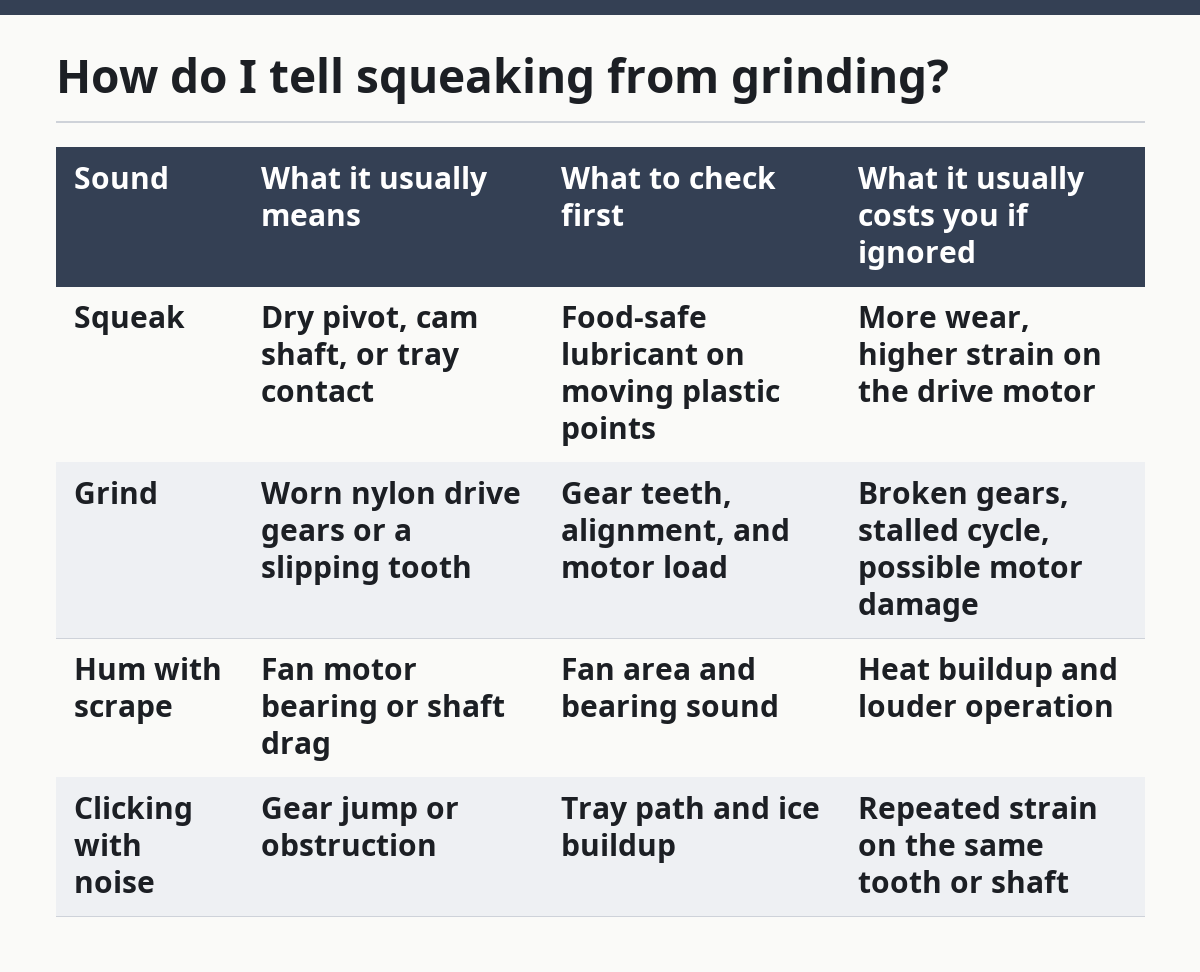
The biggest mistake is treating a grind like a squeak. A squeak can sometimes be handled with a small service fix. A grind is a warning that something is already rubbing the wrong way, and forcing the machine through another long cycle can make a small gear issue turn into a larger failure.
This is also where the internal drive motor matters. If the motor is working harder because a shaft is sticky, the noise may start as a squeak and become a grind. If the motor is already weak, it can sound rough even when the rest of the mechanism looks fine.
Where do you put food-grade silicone grease?
You put food-grade silicone grease on the moving plastic contact points, not on the ice, the water line, or the compressor area. The usual targets are the tray pivot, the cam shaft, and the gear contact points that are meant to move against each other.
Use only a food-safe product made for appliance contact areas. NSF H1 lubricants are the standard category most people look for in food-related equipment, and the eCFR entry for 21 CFR 178.3570 is one of the common U.S. references for lubricant use where incidental food contact may occur. For a general guide to food-grade lubricant standards, NSF also publishes material on H1 lubricants.
Here is the practical order that usually makes sense:
- Unplug the ice maker and remove any ice bin parts that lift out easily.
- Open only the panels needed to reach the noisy mechanism; do not force clipped covers.
- Wipe visible dust, ice residue, and old grease off the tray pivot, cam shaft, and gear teeth with a dry cloth.
- Put a small amount of food-grade silicone grease on the moving plastic contact points, not on the teeth themselves in a thick layer.
- Turn the mechanism by hand, if the design allows it, to spread the grease and feel for binding.
- Reassemble the cover and run one cycle to listen for change in tone.
A thin film is enough. A heavy layer can catch grit and make the noise worse over time. That trade-off matters: too little lubricant leaves the squeak in place, but too much grease can create a sticky paste that drags on the same nylon drive gears you were trying to protect.
Do not use cooking oil, petroleum jelly, or motor oil in the machine. Those products are the wrong match for a food appliance, and they can migrate where they should not be. This is one of those cases where “something slippery” is not the same as “the right lubricant.”
What should I inspect before I add lubricant?
You should inspect the gear teeth, shaft alignment, and fan area before adding lubricant, because grease cannot fix broken parts. If a tooth is chipped or the shaft is rubbing off-center, lubricant may hide the symptom for a cycle or two, but the noise will come back.
Start with the simplest checks. Look for ice buildup near the moving tray, loose screws on the access cover, and anything that could rub the mechanism off line. A half-misaligned cam shaft can make a new machine sound old. A stuck piece of ice can do the same thing.
Then look at the nylon drive gears. Nylon is used because it is quiet and wears in a controlled way, but that also means the teeth can wear down or chip. If the teeth look polished only on one edge, the gears are likely running under uneven load. That is a clue that the motor or shaft alignment is the issue, not just dryness.
Listen near the fan motor bearing too. A bearing noise often sounds different from a tray squeak. It can be a steady scrape or a rough whir that stays the same no matter what the tray is doing. If the sound is clearly in the fan area, grease on the tray side will not change it.
A good rule: if you can point to a single rubbing spot, lubrication may help. If the noise is spread across the whole cycle, or the machine sounds rough even when idle, the internal drive motor or another sealed part may be the real problem.
When is lubrication the wrong fix?
Lubrication is the wrong fix when the part is broken, sealed, or overheating. It is also the wrong fix when the grind comes from stripped nylon drive gears or a failing internal drive motor.
There are a few red flags that should stop the repair attempt:
- The noise is a hard grind from the first second of startup.
- The tray moves unevenly or stops in the same place each cycle.
- A gear tooth is missing, cracked, or rounded off.
- The fan motor bearing sounds rough even after the machine is cleaned.
- The motor gets louder over time instead of quieter after cleaning.
In those cases, adding grease can waste time and sometimes make diagnosis harder. A greasy broken gear can still be broken, and the extra coating can hide wear marks that would have shown you where the fault is.
This is the point where the machine may need part replacement rather than a cleaning fix. That is especially true if the noise is coming from a sealed motor section. Sealed parts are not meant to be serviced with grease on the outside, and forcing them can create more damage than the original squeak.
This page sits under the portable ice maker troubleshooting guide because the job here is narrow: identify friction noise, separate it from gear failure, and decide whether food-grade silicone grease is enough. It is not the place to chase harvest problems, restart loops, or water-feed faults.
How do I keep the noise from coming back?
You keep the noise from coming back by cleaning the moving parts regularly, using the right lubricant sparingly, and stopping the machine before wear becomes damage. A quick wipe of the tray path and a fresh check of the gear teeth can prevent the dry rub that starts most squeaks.
The main habit is simple: listen for a change in sound before the noise becomes obvious. A new squeak is easier to handle than a deep grind. If the machine starts sounding different over a few cycles, open it before the problem spreads to the cam shaft or the internal drive motor.
It also helps to avoid overloading the machine with ice buildup. Ice around the moving path adds drag, and drag is what turns a quiet mechanism into a noisy one. If the machine is in a damp spot or gets frequent use, that check matters more than the grease itself.
The honest limitation is this: not every portable ice maker noise is fixable with a little maintenance. Some units develop worn gears or failing bearings that need parts, not polish. A light service fix is useful, but it is not a cure for a worn-out motor path.
Is it normal for a countertop ice maker to squeak?
A brief squeak can happen, but it is not something to ignore. A light sound during movement often points to a dry pivot, a cam shaft that needs a small amount of food-grade silicone grease, or a bit of ice rubbing where it should not. If the squeak gets louder, lasts longer, or turns into a grind, the machine needs inspection.
Where do you lubricate a portable ice maker?
You lubricate the moving plastic contact points, mainly the tray pivot, cam shaft, and any accessible gear contact area that is designed to move. Use only food-grade silicone grease in a thin film, and keep it away from the ice path, water areas, and sealed motor parts. If the noise is coming from the fan motor bearing or a sealed drive unit, grease on the tray side will not solve it.
Drafted with AI; not yet reviewed by a person.