Last updated: November 17, 2026
To flush your machine, run an active closed-loop cycle of diluted food-grade citric acid through the internal circulation pump, followed by three gravity rinses with fresh water. This process forces descaler through the sealed fluid paths, dissolving trapped scale, algae, and mineral grit without cracking open the factory chassis.
Key Takeaways
- Circulating an acid solution under power is the only reliable way to descale internal tubing without voiding the manufacturer warranty.
- Food-grade citric acid dissolved at two tablespoons per quart of warm water strips calcium carbonate faster than standard five-percent white vinegar and leaves behind zero residual odor.
- The manifold spray bar contains micro-orifices that collect dislodged scale chips; clearing these jet holes requires direct mechanical clearing if fluid pressure drops.
- Never run the self-cleaning sequence dry; running the pump without liquid damages the internal centrifugal impeller within thirty seconds.
- Always finish a line flush by draining the reservoir through the bottom drain port plug and running at least two quarts of clean tap water straight through the system.
How does the internal circulation pump move water through hidden lines?
The internal circulation pump lifts water from the bottom basin and pushes it upward through flexible food-grade silicone tubing to reach the freezing assembly. Most countertop units, such as the Frigidaire EFIC108 or the GE Profile Opal 2.0, rely on a compact 12-volt DC centrifugal impeller submersed in the lower liquid well. In bullet-style ice makers, this pump pushes water up into an upper tray where refrigerated copper fingers sit submerged. In clear-ice and nugget-style machines, the pump generates continuous fluid circulation over a vertical evaporator plate or through an auger core.
“`
+————————————————————-+
| Freezing Assembly |
| (Evaporator Prongs / Vertical Plate / Nugget Auger Core) |
+————————————————————-+
^
| Pressurized Upflow
| (Silicone Fluid Tubes)
+————————————————————-+
| Manifold Spray Bar / Jet Holes |
+————————————————————-+
^
|
+————————————————————-+
| Centrifugal Impeller Pump |
| (Submersed 12V DC Motor) |
+————————————————————-+
^
| Suction Draw
+————————————————————-+
| Lower Basin |
| [Removable Screen] [Drain Port Plug] |
+————————————————————-+
“`
Water that does not immediately freeze cascades back into the lower reservoir, creating a continuous recirculating cleaning cycle portable ice makers depend on during regular operation. The fluid lines connecting the lower basin to the top distributor remain completely hidden behind the outer plastic casing. Unlike laboratory devices that use peristaltic flow over external hoses to push liquids without internal contact, countertop ice maker pumps bring fluid into direct physical contact with the motor housing, rotor, and drive shaft.
Because water sits inside these hidden lines between freezing sessions, trapped minerals steadily precipitate out of suspension. Calcium carbonate and magnesium salts form a hardened crust across the inner tubing walls, narrowing the internal diameter of the line. Over two to three months of regular use, this calcification restricts liquid volume, causing the pump motor to pull higher electrical current while delivering a weaker flow across the freezing elements.
Which cleaning solutions safely flush closed loop ice maker lines?
A solution of pure citric acid powder dissolved in warm distilled water is the safest and most effective fluid for breaking down mineral deposits inside internal pump lines. Citric acid reacts with scale deposits to produce soluble calcium citrate, which flushes out freely through the drainage port without releasing noxious fumes. Commercial descaling liquids formulated for coffee machines and ice makers also work, provided they use sulfamic or citric bases rather than harsh inorganic acids.
| Solution Type | Mixing Ratio | Contact Time | Mineral Removal Power | Scent & Taste Residue | Impact on Silicone & Pump Seals |
|---|---|---|---|---|---|
| Food-Grade Citric Acid | 2 tbsp per 1 quart warm water | 20 to 30 minutes | High (dissolves heavy limescale quickly) | None (rinses out completely clean) | Safe for food-grade silicone and nitrile seals |
| Distilled White Vinegar (5%) | 1 part vinegar to 1 part water | 40 to 60 minutes | Moderate (requires extended soaking) | High (requires 4 to 6 full fresh-water rinses) | Safe, but can soften low-grade rubber over time |
| Commercial Ice Machine Cleaner | Per label directions (typically 2 oz per quart) | 15 to 20 minutes | Very High (engineered for commercial nickel grids) | Low to Moderate | Safe when diluted strictly according to manufacturer specs |
| Household Chlorine Bleach | 1 tsp per 1 gallon cool water | 10 minutes maximum | Zero (sanitizes biology, does not dissolve scale) | Moderate chemical scent | Highly corrosive to pump shafts and heating elements if undiluted |
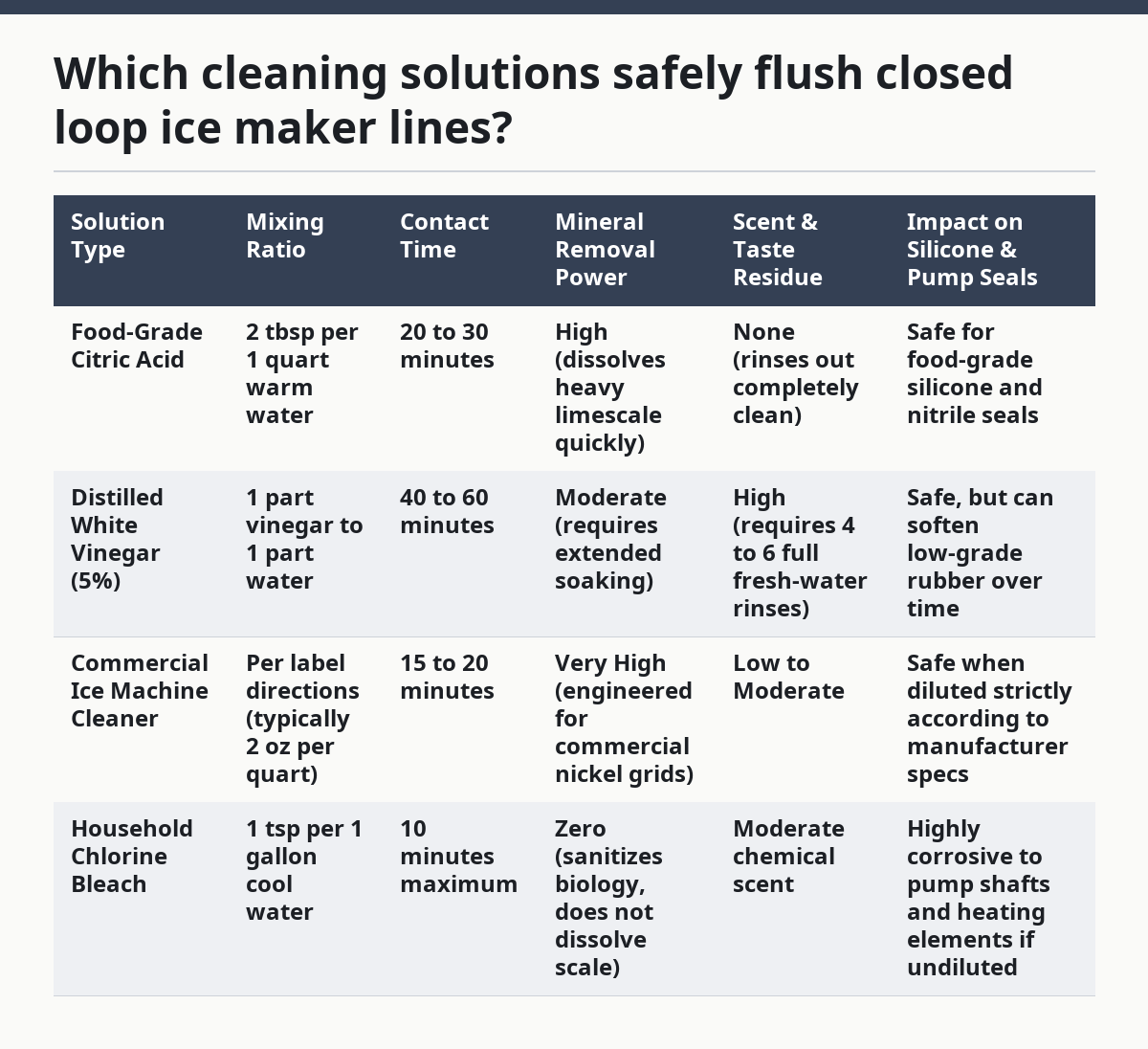
Avoid running straight five-percent household vinegar through modern internal pump assemblies unless no other descaling agent is on hand. While acetic acid removes light mineral film, it acts slowly on dense calcium plugs and leaves a pungent aromatic oil that clings to silicone tubing for dozens of ice batches. Chlorine bleach must never be mixed with descaling acids, as combining them creates dangerous chlorine gas. Keep chemical selection focused entirely on mineral-dissolving acids during the flush phase, reserving diluted sanitizing washes strictly for secondary passes.
For broader maintenance schedules and deep-cleaning steps across the rest of the chassis, consult the portable ice maker cleaning and descaling guide on sanitizing outer reservoirs and storage buckets.
How do you flush closed loop ice maker lines step-by-step?
Flushing the concealed plumbing requires preparing a cleaning solution, cycling it through the internal circulation pump under active motor power, and flushing the circuit with clean water. This practical procedure strips scale from the intake screen, pump chamber, distributor feed, and internal silicone tubes without mechanical disassembly.
Follow these steps to clean closed loop ice maker lines thoroughly:
- Disconnect electrical power and drain the reservoir. Pull the electrical plug from the 120-volt wall outlet. Position the ice maker over a sink basin, pull the rubber drain port plug from the base or rear of the machine, and allow all resting liquid to empty completely.
- Mix the descaling flush mixture. Dissolve two tablespoons (approximately 30 grams) of food-grade citric acid powder into one quart (950 milliliters) of warm tap water heated to roughly 100°F (38°C). Stir the crystals until the liquid turns completely clear so undissolved granules do not get sucked into the pump intake.
- Fill the lower fluid well. Reinsert the bottom drain port plug firmly into the drain neck. Pour the prepared citric acid mixture directly into the ice maker’s bottom reservoir until the liquid level reaches the maximum fill line embossed on the inner plastic wall.
- Engage the automated pump cycle. Restore electrical power to the appliance. Press and hold the power or cleaning button for five seconds to start the machine’s automated wash sequence, which continuously spins the centrifugal impeller without engaging the cooling compressor.
- Circulate the solution for fifteen minutes. Let the machine run its pump cycle for 15 to 20 minutes to circulate the descaling wash through the internal circulation pump, vertical line, and top tray. If the unit does not have a dedicated wash mode, select the small ice size and allow it to run for two complete ice-making dumps, discarding the resulting acidic slush cubes immediately.
- Drain the spent chemical flush. Switch off the machine, disconnect the power cord, and pull the drain port plug over your sink. Empty the yellowed or cloudy waste fluid, observing whether large mineral flakes or particulate debris flush out into the sink basin.
- Perform two continuous clean-water flushes. Replace the drain plug and fill the reservoir to the maximum line with one quart of clean, cool tap water. Power the unit on, run a five-minute wash cycle, pull the plug to drain, and repeat this freshwater step a second time to purge every trace of loosened sediment and acid.
How do you complete cleaning water distributor bar assemblies?
When cleaning the water distributor bar on a countertop ice maker, inspect the tiny liquid emission ports along the horizontal delivery tube for mineral obstructions. In units made by brands like Costway, NewAir, or Euhomy, the distributor bar sits directly above the freezing fingers or evaporative grid. The internal pump pushes water up into this distribution manifold, which splits the primary fluid path into six to twelve tiny streams that pour evenly across the freezing surface.
| Horizontal Manifold Pipe |
+–+——-+——-+——-+——-+——-+——-+——-+–+
| | | | | | | |
[•] [•] [•] [•] [•] [•] [•] [•] <– Jet Ports
| | | | | | | |
v v v v v v v v
+————————————————————-+
| Freezing Evaporator Fingers / Grid |
+————————————————————-+
“`
Scale flakes broken free by the internal pump flush frequently lodge behind these tiny output holes. When ports clog, water flow turns uneven, producing undersized, hollow, or misshapen ice bullets on one side of the freezing tray while the other side runs dry. If the pump can be heard running smoothly but water trickles out unevenly, the distributor manifold requires mechanical clearing.
Take an unbent metal paperclip, a 0.035-inch guitar string, or an interdental dental brush to service the manifold. While the chemical cleaning mixture sits in the upper tray during a paused wash cycle, push the wire tip directly into each individual jet hole on the spray bar. Work the wire in and out using light pressure to pulverize caught mineral grit. Once cleared, resume the pump cycle for two minutes to let line pressure blast the loosened particulate out of the newly opened nozzles.
What common flushing mistakes damage internal pumps?
The most destructive mistake when servicing an ice machine is allowing the internal circulation pump to run dry during a cycle. Small appliance water pumps rely entirely on the liquid they pump to lubricate the tight clearance between the rotor magnet and the plastic housing. If you engage a cleaning mode or ice production cycle while the bottom reservoir sits empty, the spinning centrifugal impeller generates dry friction heat. The shaft sleeve can melt, warp, or seize permanently within forty-five seconds of unlubricated operation.
Another expensive error involves pouring boiling water into the ice maker to speed up mineral dissolution. While hot water does dissolve limescale faster, water exceeding 120°F (49°C) softens the thin-walled internal silicone lines, potentially causing them to slip off their barbed plastic connectors inside the sealed casing. High temperatures can also crack the rigid ABS plastic sump basin and warp the delicate rotor casing inside the submersed motor. Always keep flush mixtures warm to the touch, hovering between 90°F and 105°F (32°C to 40°C).
Skipping the final gravity rinse is an equally costly mistake that ruins subsequent ice production. Chemical descaling agents strip scale by converting mineral hardpack into a loose, acidic slurry. If you leave that fluid inside the machine’s sump, microscopic dissolved salts settle into the pump’s bottom intake screen as the liquid cools. The next batch of ice cubes will taste sour, carry a chemical film, and freeze into weak, cloudy slush that melts within minutes of dropping into the storage basket.
Finally, using powdered descaling products without dissolving them beforehand causes instant physical jams. Pouring dry citric acid crystals or powdered commercial descalers straight into the ice machine reservoir allows dense crystals to get pulled directly against the intake grate. The suction draws undissolved granules into the impeller housing, locking the magnetic drive rotor and burning out the low-voltage control board’s pump drive circuit. Always mix chemicals in a separate glass measuring cup until completely clear before pouring them into the machine.
Who should not attempt an internal closed loop chemical flush?
Do not attempt a pressurized chemical flush if your ice maker has sat unused with standing water inside for more than six months. Extended stagnant storage causes rubber gaskets to dry out and allows dense, structural biological colonies to fuse across the fine plastic intake filter of the pump. Pumping an acidic chemical solution through a neglected system often breaks free large, rubbery chunks of biofilm that instantly pack the internal intake throat solid, burning out the motor winding within minutes.
Units showing visible electrical shorting, cracked outer plastic floor pans, or persistent error codes related to pump electrical failure should not be flushed with liquid solutions. If a machine displays an “E1” or “Water Empty” warning light while the reservoir is completely full, the issue typically stems from a failed water level sensor pin or an open circuit in the pump coil rather than a mere plumbing clog. For diagnostic standards regarding safe residential appliance repair and electrical safety, refer to the published guidelines from Underwriters Laboratories (UL 563) covering commercial and consumer ice makers.
Commercial countertop ice dispensers that incorporate sealed inline carbon filters or reverse-osmosis feed connections require external line isolation before running internal cleaning cycles. Pushing concentrated citric acid or commercial chemical descalers backward through integrated water purification filters destroys the carbon bed and ruins the microscopic pores of reverse-osmosis membranes. In hard-plumbed installations, close the primary supply valve, bypass the filtration banks, and feed descaling solutions strictly through a dedicated sanitation intake port.
Troubleshooting Fluid Flow Issues During a Line Flush
If the internal circulation pump hums during a cleaning sequence but fails to move fluid up to the distributor bar, an air lock is likely trapped inside the pump cavity. Centrifugal pumps cannot pump air; when a bubble gets trapped inside the impeller housing, the blades spin freely in the void without creating enough suction to pull water up from the reservoir.
| Air Lock Clearing Steps |
+————————————————————-+
| 1. Fill reservoir 1/2 inch ABOVE the maximum fill line. |
| 2. Lift front edge of machine 2 inches; drop gently. |
| 3. Cycle the power button on and off three distinct times. |
| 4. Verify steady stream from upper distribution manifold. |
+————————————————————-+
“`
To break an air lock without opening the machine’s shell:
- Top off the lower reservoir with warm water until the fluid level sits half an inch above the maximum line, increasing the head pressure pushing down on the pump intake.
- Lift the front edge of the ice maker two inches off the counter and set it down firmly to dislodge
Drafted with AI; not yet reviewed by a person.