Prevent mold in a portable ice maker by draining and drying the reservoir and bin whenever the unit sits unused, and changing standing water at least every 24 hours while it’s in use. This matches both the manufacturers’ own instructions and the EPA’s general rule that drying a wet area within 24-48 hours usually stops mold from growing in the first place.
- Manufacturers don’t publish a mold-specific cleaning schedule — the real instruction is simpler: drain, dry, and don’t let water sit.
- Mold and mildew look and feel different from mineral scale: fuzzy or slimy versus hard and chalky. The visual guide below shows both side by side.
- The EPA’s 24-48-hour drying principle for general moisture control lines up closely with what Igloo and hOmeLabs already tell owners to do — it isn’t an ice-maker-specific EPA finding, but the two agree.
- A musty smell, even without visible spots, is a sign standing water has been sitting too long somewhere in the unit.
- For the full descaling routine and a maintenance-frequency table by water hardness, see our cleaning and descaling guide.
Why does mold grow in a portable ice maker at all?
Because it’s a small, enclosed space that holds standing water at room temperature between cycles, and mold needs exactly that: moisture, a surface to grow on, and time. The U.S. Environmental Protection Agency’s general guidance on mold and moisture control puts it plainly: “the key to mold control is moisture control.” That’s not an ice-maker-specific statement — the EPA doesn’t publish guidance about ice makers — but the mechanism applies the same way inside a water reservoir as it does on a damp windowsill.
Portable ice makers are more exposed to this than a refrigerator’s built-in ice maker, because they’re not refrigerated when idle and often get used for a few days, then left alone with water still inside. Rubber gaskets, lid seals, and corners of the bin are the spots most likely to stay damp longest after the unit stops running, which is exactly where mold and mildew tend to show up first.
How do you tell mold apart from mineral scale or normal residue?
This trips people up because all three can look like “something’s dirty in there” at a glance. Color, texture, and location are the practical differences, and none of them need a lab test to spot.
| What you see | Mold / mildew | Mineral scale | Normal residue |
|---|---|---|---|
| Color | Black, dark green, gray, or pink spots | White, off-white, or cloudy gray-yellow film | Clear or a very faint white haze |
| Texture | Fuzzy, slimy, or velvety | Hard, chalky, or crusty — flakes rather than smears | Smooth, thin film that wipes off easily |
| Where it shows up | Rubber gaskets, corners, bin lid seal, anywhere water sat still | Evaporator fingers, water tray, tank walls (worse with hard water) | Tank sides after water evaporates slightly |
| Smell | Often musty | None | None |
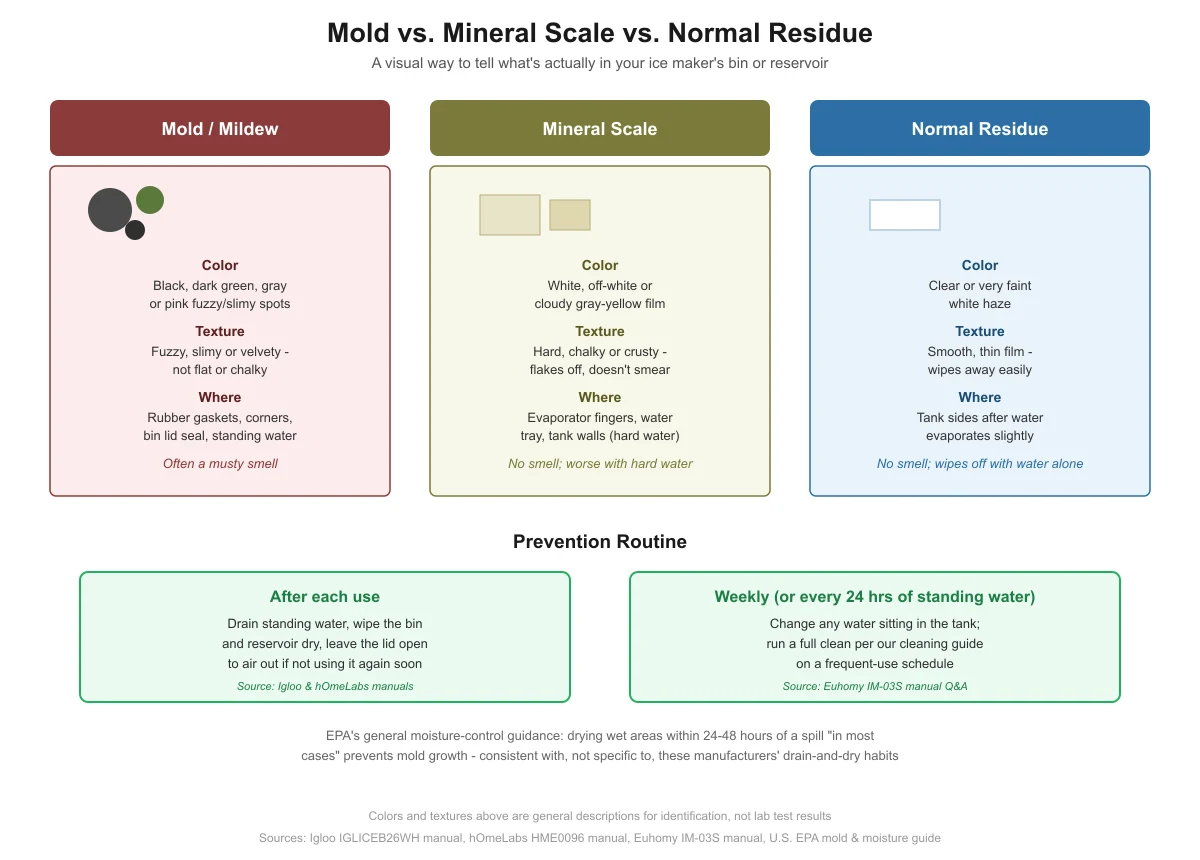
If what you’re looking at is hard and chalky rather than fuzzy or slimy, that’s mineral scale, not mold, and the fix is descaling rather than disinfecting — our cleaning and descaling guide covers that method and a frequency table by water hardness.
What’s the actual prevention routine, and where does it come from?
Two real, manufacturer-published habits do almost all the work here, and both are about moisture, not chemicals:
- Change the water every 24 hours while the unit is in use. Igloo’s IGLICEB26WH manual and hOmeLabs’ HME0096 manual both instruct changing the water in the reservoir at least every 24 hours during regular use.
- Drain and dry it completely whenever it’s not in use. Igloo’s manual specifically says to “drain all water left in the Water Reservoir” if the unit isn’t being used, and to “always open the Water Drain Plug and completely drain the water” before longer-term storage. hOmeLabs’ manual gives the same instruction: drain all the water and dry the tank if you’re not going to use it.
Neither manual states a cleaning frequency aimed specifically at preventing mold — the closest real manufacturer number for a full clean is Euhomy’s weekly-with-frequent-use cadence, covered in our cleaning guide, and that’s a descaling schedule, not a mold-specific one. The drain-and-dry habit above is the actual mold-prevention instruction, and it’s consistent with the EPA’s general 24-48-hour drying principle for moisture control, even though the EPA has never studied ice makers specifically.
What should you do after every single use?
If you’re not planning to run the machine again within a day, do this each time you finish:
- Drain any water still sitting in the reservoir through the drain plug.
- Wipe the bin and reservoir dry with a clean cloth — don’t just tip the water out and close the lid on a damp interior.
- Leave the lid open for a while to let the inside air out, rather than sealing in any remaining moisture.
This takes under a minute and is the single habit that does the most to stop mold before it starts, because it removes the standing water mold needs in the first place.
What should you do weekly, or whenever the unit is in frequent use?
On top of the after-each-use habit, change any water that has been sitting for close to 24 hours even if you’re using the machine regularly, and build in a weekly full clean — see our cleaning and descaling guide for the step-by-step method and a maintenance-frequency table broken out by water hardness and usage level. That guide’s schedule is anchored to Euhomy’s published weekly cadence, the clearest manufacturer number in our research.
I already see mold or mildew — how do I remove it?
Start by removing and fully draining the reservoir and bin, then wash the affected surfaces with warm water and mild detergent, paying extra attention to rubber gaskets and seals where mold tends to concentrate. Rinse thoroughly — at least twice — before refilling, and let every part dry completely in open air before you reassemble the unit. If mold keeps coming back on a gasket or seal after repeated cleaning, that part may need replacing, since porous or textured rubber can hold onto mold roots that a surface wipe doesn’t fully remove.
No official source in our research specifies a disinfectant product or a “kills X% of mold” claim for ice maker parts, so we’re not recommending a specific product here. A mild detergent and thorough drying, repeated consistently, is the documented approach that matches what the manufacturers themselves instruct.
Does this matter differently for RV or camper use?
It does, mainly because RV trips often mean the unit sits packed away, powered off, with water still inside for days between uses — exactly the condition mold needs. If you’re using or considering a portable ice maker for a camper or RV, see our RV and camper power guide for placement and power planning, and make draining and drying before storage part of your packing routine, not an afterthought.
Frequently asked questions
Is a musty smell always a sign of mold, even without visible spots?
A musty smell is a reasonable warning sign that water has been sitting somewhere in the unit longer than it should, even before mold becomes visible. Drain and dry the reservoir and bin thoroughly, and check gaskets and seals closely, since mold often starts in those crevices before it’s easy to see.
Can I use bleach to remove mold from my ice maker?
None of the manufacturer manuals in our research recommend bleach for cleaning these units, and we’re not recommending it here. If you do use any bleach-based product near your ice maker, never mix chlorine bleach with vinegar or ammonia-based cleaners — that combination produces dangerous fumes — and rinse any cleaning product thoroughly before the unit touches drinking ice again.
Does running the unit daily prevent mold better than occasional use?
Not automatically — frequent use still involves standing water, so the 24-hour water-change habit matters just as much, if not more, since the reservoir is refilled and used more often. What helps most is consistency: change the water on schedule and don’t let the unit sit with water inside when you’re done for the day.
Is mold in a portable ice maker dangerous to ingest from the ice?
We’re not aware of an official health guideline specific to mold in ice maker ice, and we’re not making a medical claim here. The practical approach is prevention: if you see or smell mold, don’t use ice from that batch, clean the unit thoroughly as described above, and let everything dry fully before making more ice.
Why does mold keep coming back in the same spot even after I clean it?
Rubber gaskets and seals are porous and textured, which can let mold take hold below the surface in a way a quick wipe doesn’t fully remove. If mold returns repeatedly in the same gasket or seal despite thorough cleaning and drying, that part likely needs replacing rather than repeated cleaning.
Sources
- U.S. EPA, A Brief Guide to Mold, Moisture and Your Home — read November 2026
- Igloo IGLICEB26WH Owner’s Manual, distributed by Nostalgia Products LLC — read November 2026
- hOmeLabs HME0096 “Bullet Ice” Portable Ice Maker Manual, hOmeLabs LLC — read November 2026
portableicemakerly.com Editorial Team. Last updated: November 13, 2026.