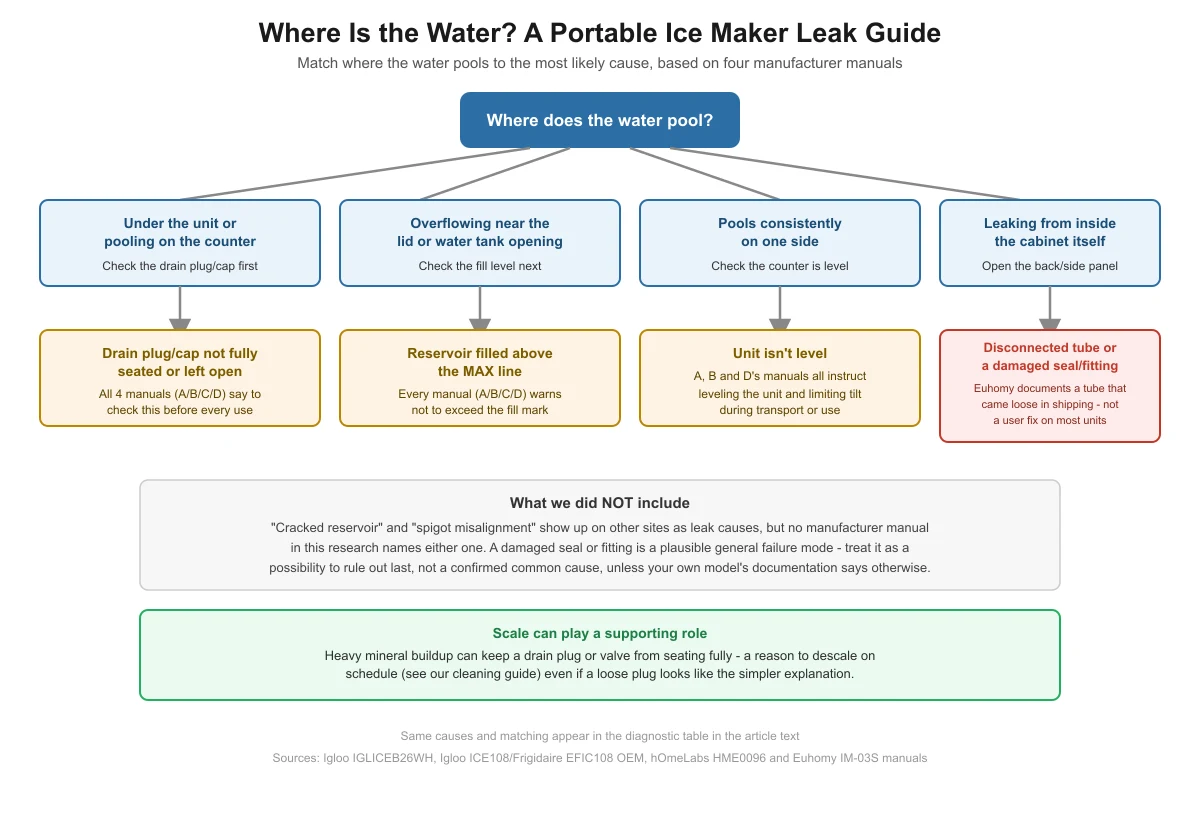
A portable ice maker usually leaks because the drain plug isn’t fully seated, the reservoir was filled past the MAX line, or the unit isn’t sitting level — all three are instructions found across four manufacturer manuals. Where the water actually pools tells you which one to check first, before you assume something inside the machine is broken.
- Check the drain plug or cap first if water is pooling under the unit or on the counter in front — every manual in this research flags this as a before-every-use check.
- Overfilling the reservoir past its MAX line is a directly documented cause across all four manuals, not a guess.
- An unlevel counter or surface is explicitly called out as a malfunction risk in three of the four manuals.
- We’re not stating “cracked reservoir” or “spigot misalignment” as confirmed common causes — no manufacturer manual in our research names either one, so we present a damaged seal or fitting as a general, less-common possibility instead.
- If the leak comes with scale buildup or shrinking ice, your maintenance routine may be part of the problem — see our cleaning and descaling guide.
Where is the water actually coming from?
Before troubleshooting any single part, figure out where the water first appears, because that narrows the likely cause fast. We cross-checked four manufacturer manuals — Igloo’s IGLICEB26WH, the Igloo ICE108 manual used for a rebadged Frigidaire-branded unit, hOmeLabs’ HME0096, and Euhomy’s IM-03S — and the instructions line up closely on what actually causes leaks in this category of appliance.
What’s the diagnostic table for portable-specific leak causes?
This table matches where you see water to the cause the manufacturers themselves document, in the order worth checking.
| Where the water pools | Most likely cause | What manufacturers actually say |
|---|---|---|
| Under the unit or pooling on the counter in front | Drain plug or cap not fully seated, or left open | All four manuals instruct checking the drain plug/cap is closed before every use |
| Overflowing near the lid or water tank opening | Reservoir filled above the MAX line | Every manual warns not to exceed the fill mark; excess water needs draining or it can leak |
| Pools consistently on one side | Unit isn’t level | Igloo, the Igloo ICE108 manual, and Euhomy all instruct leveling the unit and limiting tilt during transport or use |
| Leaking from inside the cabinet itself (visible when you open a panel) | A disconnected internal tube, or more generally a damaged seal or fitting | Euhomy’s own manual documents an internal tube that can come loose during shipping as a named cause for its unit specifically |
How do you check and fix a drain plug that’s leaking?
Unplug the unit, then check that the drain plug or cap is pushed in fully and seated square, not just resting in the opening. On models with a screw-type cap, make sure it’s turned until snug rather than hand-tight only. If the plug looks fine but still seeps, inspect the rubber gasket or O-ring on the plug itself for cracking or a buildup of mineral scale that’s keeping it from seating flush — heavy scale is a plausible reason a plug that used to seal properly stops doing so, which is part of why staying on a descaling schedule matters even for leak prevention.
How do you fix a reservoir that’s overfilled?
Drain the reservoir down to the MAX line marked inside the tank, then refill more carefully, checking the mark as you go rather than filling by eye. Every manual in this research treats the fill line as a hard limit, not a suggestion — water above it has nowhere to go but out, whether through a vent, around the lid, or down the sides of the unit.
How do you check whether the unit is actually level?
Set a small level on top of the unit, or simply watch whether a full glass of water sitting next to it looks even, and check the counter itself isn’t tilted. Igloo’s manual and the Igloo ICE108 manual both warn against operating or transporting the unit at a steep angle, and Euhomy’s manual requires a flat, even surface. An unlevel unit can let water pool unevenly inside the base or reservoir instead of draining or distributing the way the machine expects, which shows up as a leak on one side rather than a uniform drip.
What if the leak is coming from inside the unit itself?
This is the case worth being most cautious about naming a cause for. Euhomy’s own manual documents one specific, brand-confirmed example: an internal tube that can disconnect during shipping, which the company says you can reconnect yourself after removing the back cover, or get help with from its support team. That’s a real, named mechanism — for that brand.
Beyond that one documented case, we did not find “cracked reservoir” or “spigot misalignment” named as common leak causes in any of the four manuals we reviewed, even though both show up frequently on other sites covering this topic. If you open your unit and find damage, the more accurate and honest way to describe it is a damaged seal or fitting — a general, plausible failure mode — rather than stating a specific unverified mechanism as if it were confirmed. In either case, an internal leak behind a panel is usually a manufacturer support or warranty question, not a DIY fix, unless your own unit’s documentation says otherwise.
Could a cleaning or scale problem be causing the leak?
Indirectly, yes. Heavy mineral scale can build up around a drain plug or valve seat over time, which is a plausible reason a fitting that sealed properly when the unit was new starts seeping later. This doesn’t mean every leak is a cleaning problem, but if your unit also shows signs of scale — a white, chalky film on the evaporator fingers or tray — or has been producing smaller or hollow cubes, it’s worth working through our cleaning and descaling guide alongside the leak fix, since the two can share a root cause.
When does a leak mean the unit isn’t making ice properly either?
If you’re seeing both a leak and a drop in ice output — slower cycles, smaller cubes, or the unit simply not making ice — treat them as related symptoms worth troubleshooting together rather than two separate problems. Our step-by-step troubleshooting guide for a portable ice maker that isn’t making ice walks through the order of checks manufacturers themselves recommend, starting with power and water level before anything that needs a technician.
When should you stop and contact support instead of troubleshooting further?
Stop and contact the manufacturer if you’ve checked the drain plug, fill level, and leveling and the leak continues, if you find damage inside the cabinet beyond a simple disconnected tube you’re confident reattaching yourself, or if the leak is accompanied by unusual noise, smell, or any sign of electrical involvement. None of the four manuals in this research treat internal refrigerant or wiring issues as user-serviceable, and neither should you.
Frequently asked questions
Is a small amount of water around a portable ice maker always a leak?
Not necessarily — some condensation on the exterior is normal, especially in a warm or humid room. A true leak is water that keeps reappearing after you dry the area, or that pools consistently under or beside the unit rather than just lightly beading on the outside surface.
Can an overfilled reservoir damage the ice maker, not just leak?
The manuals in our research focus on overfilling as a leak and spill risk rather than describing internal damage from it, but consistently exceeding the MAX line isn’t good practice regardless. Drain back down to the fill line and refill carefully using the marked level as your guide.
Should I keep using the unit while a leak is happening?
Unplug the unit and address the leak first, both to avoid repeated water damage to your counter or floor and to rule out causes like a loose drain plug before assuming anything more serious is wrong. Most of the causes in the table above are quick, zero-tool checks.
Does leveling really make that much difference on a small countertop unit?
Yes, based on what the manufacturers themselves instruct — Igloo, the Igloo ICE108 manual, and Euhomy all specifically call out keeping the unit level and limiting tilt during use or transport. On a compact appliance, even a modest tilt can be enough to send water somewhere it isn’t designed to go.
Is “cracked reservoir” ever a real cause, even though you didn’t confirm it?
It’s plausible as a general failure mode for any plastic water-holding part, but no manufacturer manual in our research names it as a documented leak cause for these specific units. If you suspect physical damage to the reservoir itself, that’s a case for contacting the manufacturer rather than assuming it from a leak alone.
Sources
- Igloo IGLICEB26WH Owner’s Manual, distributed by Nostalgia Products LLC — read November 2026
- Igloo ICE108 Owner’s Manual (OEM manual listed for the Frigidaire EFIC108-SILVER countertop ice maker) — read November 2026
- hOmeLabs HME0096 “Bullet Ice” Portable Ice Maker Manual, hOmeLabs LLC — read November 2026
- Euhomy IM-03S Ice Maker Manual, Euhomy — read November 2026
portableicemakerly.com Editorial Team. Last updated: November 13, 2026.

One thought on “Portable Ice Maker Leaking Water: Causes and Fixes”