Last updated: November 18, 2026
Quick answer: 1 cleaner is the better default for most portable ice makers. Citric acid is usually the better descaling solution; white vinegar is the backup if you already have it or want a cheap, mild cleaner. The topic here is Descaling Portable Ice Makers: Citric Acid vs White Vinegar, and the main reason is simple: citric acid dissolves mineral scale well without leaving the sour smell that acetic acid from white vinegar often leaves behind, which matters inside a small machine with rubber gaskets and a nickel-plated evaporator.
This comparison is for people deciding between two common descalers, not for mold removal or sensor cleaning. It also helps if the goal is protecting elastomer seals and the evaporator coating, which are the parts most likely to care about repeated chemical exposure.
Key takeaways
- Citric acid is usually the cleaner pick for portable ice makers because it rinses out with less lingering odor.
- White vinegar can work, but the acetic acid smell can stay in the water path and show up in ice.
- Nickel plating and elastomer seals make the choice less about “stronger cleaner” and more about “less side effect”; if the machine has unusual corrosion or seal damage, check the manual or consult a qualified appliance technician.
- If the machine already smells like vinegar after cleaning, the fix is usually a better rinse, not a harsher cleaner.
- Neither option is right for a machine with visible black mold or a separate sensor problem.
What is the real difference between citric acid and white vinegar?
Because these cleaners behave differently, citric acid wins on rinse quality, while white vinegar wins on convenience. Citric acid powder gives a cleaner final result because it is easier to rinse away completely, while white vinegar brings acetic acid and a smell that can linger in the tank, pump path, and bin if the rinse is rushed.
The chemistry is different in a way that matters. Citric acid is a stronger chelator for mineral scale, so it grabs calcium and other deposits more effectively than plain vinegar in many home-cleaning jobs. White vinegar, usually around 5% acetic acid, can still soften scale, but it often needs more patience and more rinse cycles to stop tasting like vinegar.
| Criteria | Citric acid | White vinegar | Winner for [condition] |
|---|---|---|---|
| Mineral scale removal | Good on calcium scale and hard-water residue | Can loosen light scale, but slower on stubborn buildup | Citric acid for regular descaling |
| Rinse odor | Low when rinsed well | Strong sour odor can linger | Citric acid for ice-flavor cleanup |
| Effect on nickel plating | Generally gentler when mixed and rinsed properly | More likely to leave smell and repeated exposure concerns | Citric acid for nickel-plated evaporators |
| Effect on elastomer seals | Usually better tolerated in brief descaling cycles | Can be harsher if left sitting too long | Citric acid for seal care |
| Cost and availability | Powder must be bought ahead of time | Easy to find in most kitchens | White vinegar for convenience |
| Mixing control | Easy to set a chosen ratio | Fixed as bottled vinegar strength | Citric acid for consistent cleaning |
| Odor after cleaning | Minimal after rinse | Vinegar smell is common | Citric acid for taste-sensitive users |
| Best for quick household use | Good, but requires one extra step to mix | Very easy to pour and use | White vinegar for a one-off cleanup |
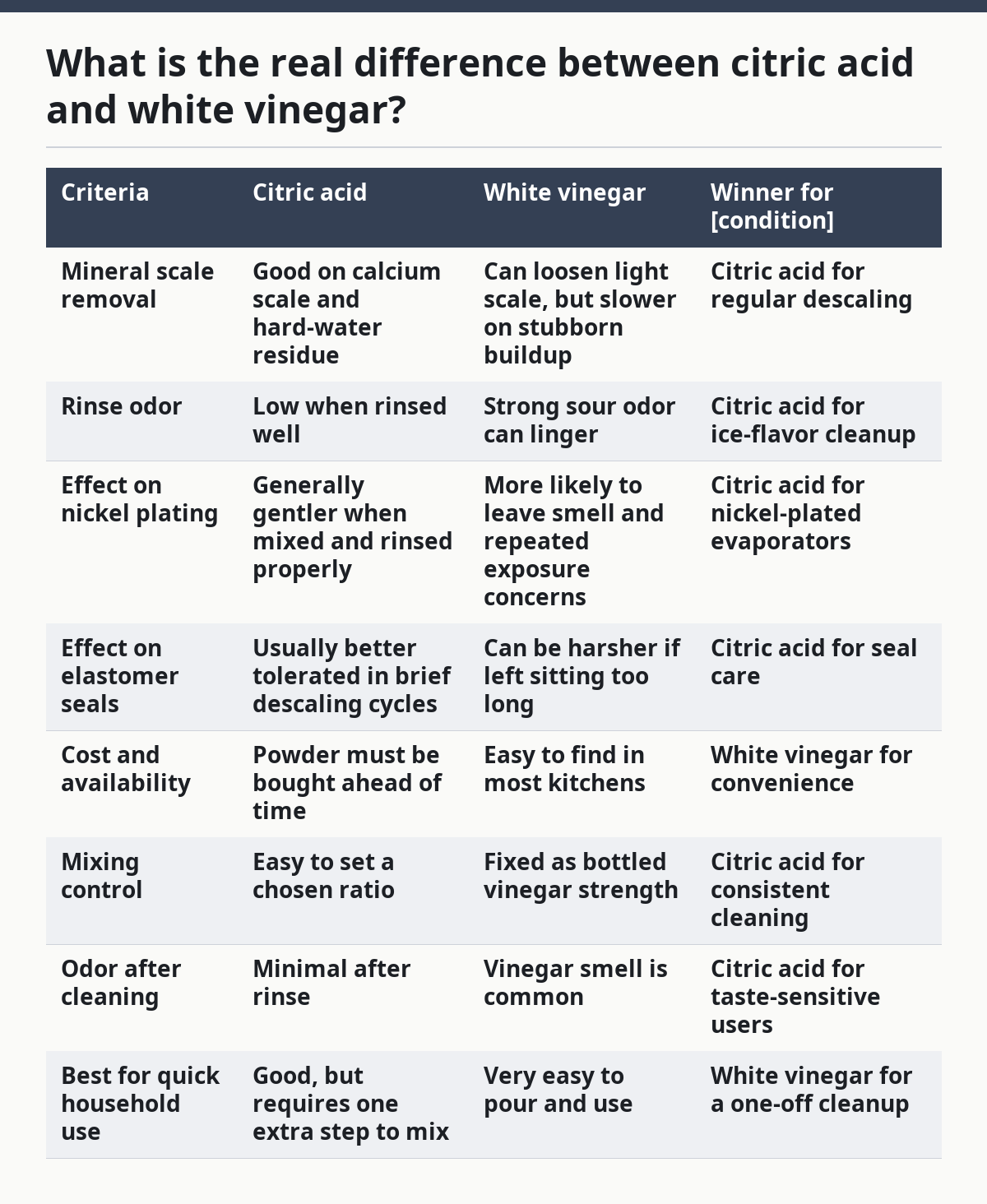
The biggest difference is not strength. It is side effects, and if a machine keeps smelling wrong after cleaning, a technician or the manufacturer’s support line is worth consulting. If the machine’s water path or bin keeps tasting like salad dressing after cleaning, that is usually a vinegar problem, not a descaling problem.
When does citric acid make more sense?
Because the water path is small, citric acid is the better choice for anyone who wants the best balance of scale removal and low residue without turning routine maintenance into a smell problem. That matters in a portable ice maker because even a little leftover odor shows up in the next batch of ice.
It is also the better choice for a machine with a nickel-plated evaporator coating. Nickel plating can handle normal cleaning, but a descaler that rinses clean is the safer everyday habit. The same logic applies to elastomer seals, which should not sit in a cleaning bath longer than needed.
Citric acid powder is the cleaner option when the goal is preventive maintenance every few weeks, or after hard-water use. It is also the better pick if the machine already had a vinegar smell before and the user wants to stop that problem instead of masking it with more rinsing.
What citric acid is not for: someone who wants a grab-and-go liquid from the pantry and does not want to mix anything. It is also not the answer for black mold or a sensor fault. Those are different problems and need a different article.
For a reader who wants one sentence to remember, this is it: citric acid is the safer default for portable ice makers because it is easier to rinse out and less likely to leave the machine smelling like vinegar.
When does white vinegar still make sense?
Meanwhile, white vinegar wins when convenience matters more than finish quality. If the machine needs a basic descale and vinegar is already in the cabinet, it can do the job without buying anything else.
That said, the trade-off is real. White vinegar contains acetic acid, and acetic acid is more likely to leave a smell in the reservoir, lines, and bin if the rinse step is sloppy. In a countertop ice maker, that smell is not a small issue; it can become a flavor complaint on the next cycle.
White vinegar is the better temporary choice for someone cleaning a machine that is already due for maintenance and does not have a sensitive nose. It is also fine for a first pass on light scale, especially if the machine will be flushed several times afterward with clean water.
Who should skip vinegar: anyone with a machine that has already had lingering taste complaints, anyone who hates extra rinse cycles, and anyone trying to be careful with a nickel-plated evaporator and rubber seals over the long run. The chemistry is not disastrous, but the smell penalty is common enough that it changes the choice.
If the question is “will vinegar ruin my portable ice maker,” the answer is no, not by itself. The more likely problem is a sour aftertaste if the cleaner is not fully rinsed out.
The honest side-by-side
Therefore, citric acid is the better general recommendation, but vinegar is still usable when the situation is simple. The point of the comparison is not to crown a miracle product; it is to match the cleaner to the machine and the user’s tolerance for smell, rinsing, and repeat maintenance.
| Criteria | Citric acid | White vinegar | Winner for [condition] |
|---|---|---|---|
| Descaling power on mineral buildup | Strong and reliable for regular scale | Works, but often slower | Citric acid for hard-water maintenance |
| Ice taste after cleaning | Less likely to affect flavor | Can leave a vinegar note | Citric acid for taste-sensitive users |
| Effect on nickel plating | Better fit for repeated use when rinsed properly | Fine for occasional use, but smell is common | Citric acid for nickel-plated evaporators |
| Effect on elastomer seals | Usually the safer routine choice | Can be less forgiving if left to soak | Citric acid for seal care |
| Ease of use | Must be mixed | Ready to pour | White vinegar for speed |
| Rinse burden | Usually lighter | Usually heavier | Citric acid for low-fuss cleanup |
| Odor control | Better | Worse | Citric acid for small kitchens |
| Budget and availability | Requires citric acid powder | Common household item | White vinegar for one-time convenience |
The table points to one practical conclusion: use citric acid when the machine is worth taking care of, and use vinegar when the job is basic and the smell does not matter much. The choice is less about raw cleaning strength than about what you do not want left behind.
Which one should I choose for my portable ice maker?
Ultimately, choose citric acid if the machine makes ice for drinking, if odor matters, or if the evaporator has nickel plating and you want the cleaner rinse. Choose white vinegar if you need a quick fix, already have it at home, and can tolerate a stronger rinse smell.
That call is especially clear for people who use the machine often. A portable ice maker is not a bathtub or a drain line; it is a small food-contact appliance where lingering taste matters as much as scale removal. A cleaner that leaves less residue is usually the better long-term choice, even if it takes one extra step to mix.
The recommendation is not the same for every user. Someone who cleans the machine occasionally and never notices vinegar taste may be fine with vinegar. Someone who has already smelled vinegar in the ice should move to citric acid and stop arguing with the aftertaste.
The best fit is usually the simplest one to remember: citric acid for routine care, white vinegar for occasional convenience. That is also the cleaner choice for readers following the broader portable ice maker cleaning guide and ice maker maintenance advice on this site.
When should I choose neither?
Before picking either cleaner, rule out black mold, a damaged gasket, or a sensor issue. Descaling does not fix those problems, and adding more acid to a machine with a mechanical fault can waste time and leave the real issue untouched.
Neither option is wise if the machine has a visibly cracked elastomer seal or a persistent leak. Cleaning solution cannot restore a worn part, and a leak can turn a simple maintenance job into a bigger repair.
If the machine has a strong odor after a previous vinegar cleaning, the next step is usually a careful rinse, not more vinegar. If the machine has heavy mineral crust that keeps returning, the better answer may be more frequent maintenance rather than a stronger household acid.
For readers who want a source on the chemistry behind the two acids, PubChem has compound pages for acetic acid and citric acid, and the U.S. National Library of Medicine maintains those records. That is useful background, but the practical choice for a portable ice maker still comes down to smell, rinse burden, and how much you want to protect the internal parts. See PubChem’s acetic acid record and PubChem’s citric acid record for compound data.
Will vinegar ruin my portable ice maker?
No, vinegar will not usually ruin a portable ice maker by itself. The main risk is residue smell and taste if the machine is not rinsed well after cleaning, especially in a small water path where acetic acid can linger.
That risk matters more than the cleaning step itself. White vinegar can help with light scale, but it is a poor choice if the goal is odor-free ice or if the machine already has a taste problem.
How much citric acid do I put in a countertop ice maker?
Because the label and directions can vary, use the amount on the product label first. If no label guidance is available, start with a mild cleaning mixture rather than a strong one, then rinse the machine thoroughly so no powder or sour taste remains.
The exact ratio depends on the cleaner and the machine’s tank size, so a fixed number would be guesswork here. For a countertop ice maker, the safer habit is a gentle mix, a short descaling cycle, and a clean-water flush afterward.
Drafted with AI; not yet reviewed by a person.