Last updated: November 17, 2026
Quick answer: if the compressor runs but the portable ice maker does not get cold, the sealed system is the first place to suspect, and the most common repair split is between a bad start relay and a sealed-system fault. The usual split is simple: either the compressor is not starting the refrigeration cycle properly, or the capillary tube, refrigerant charge, or heat exchange coil has failed in a way that keeps cold from moving through the machine.
Key takeaways
- A running compressor does not prove the ice maker is cooling; the sealed system can still fail.
- A bad ptc start relay can make the compressor hum, click, or start and stop without useful cooling.
- A clogged capillary tube or lost refrigerant usually needs sealed-system service, not a quick reset.
- If the fan runs but the cabinet stays warm, the problem may be airflow, relay failure, or a sealed-system fault.
- A portable ice maker with a sealed-system problem is often a repair-or-replace decision, not a simple parts swap.
What does a running compressor mean?
A running compressor means the hermetic compressor is getting power, but it does not mean refrigerant is moving the way it should. In a healthy portable ice maker, the compressor, capillary tube, and heat exchange coil work as one sealed loop, and that loop should create a cold evaporator surface within a short run cycle.
The clue many people miss is the difference between sound and cooling. A compressor can buzz, hum, or even stay on for minutes while a bad relay, blocked capillary tube, or refrigerant leak keeps the system from dropping temperature enough to make ice. That is why this symptom points to the sealed system, not just the control board.
A portable ice maker can also look alive in a misleading way. The fan may spin, lights may stay on, and the compressor case may feel warm, yet the ice tray area never gets cold enough to form solid cubes. That pattern is common when the machine has lost refrigerant or when the heat exchange coil is not shedding heat as it should.
Therefore, a basic way to think about it is this: if power is reaching the compressor but the cold side never develops, the failure is either in the compressor start path or inside the sealed refrigeration loop. The first is sometimes repairable with a relay or capacitor-style start part if the design uses one. The second often is not worth repairing on a countertop machine.
Is the ptc start relay the problem?
A bad ptc start relay is one of the first parts to check when the compressor runs but the ice maker does not cool. This part helps the hermetic compressor start; if it fails, the compressor may click, stall, overheat, or run without building useful refrigeration.
The common clue is a repeated click or a compressor that starts for a moment and then drops out. In that case, the relay may be opening too soon or not passing the right start current. Some portable ice makers will try again after a short pause, which makes the problem sound like a cycle issue when it is really a start issue.
Use this simple diagnostic order:
- Unplug the unit for 10 minutes. This gives the compressor time to cool down and resets a temporary thermal overload if the design has one.
- Listen for a click, hum, or repeated restart sound when power returns. A single click with no steady compressor run points toward a start device problem.
- Check whether the fan runs but the compressor only hums. That pattern often means the fan circuit is alive while the compressor start path is weak.
- Inspect the relay area for heat damage or a burnt smell. Dark plastic, melted terminals, or a loose connection can stop the compressor from starting cleanly.
- Replace the relay only if the machine uses a serviceable part and the compressor itself is not seized. If the compressor still fails to start with a known-good relay, the fault is deeper.
The trade-off here is that a relay swap is cheap compared with a sealed-system repair, but it only solves start problems. It does not fix a refrigerant leak, a blocked capillary tube, or a failed compressor valve set. If the machine runs with a new relay and still stays warm after a normal cycle, the relay was not the main fault.
A compressor relay click ice maker symptom is useful because it narrows the fault fast. It tells you the machine is trying to start, not that it has a cooling problem by itself.
How do I tell a sealed-system fault from an airflow problem?
A sealed-system fault usually shows up as warm tubing, weak or no frost, and no real temperature drop, while an airflow problem usually shows up as poor heat removal on the hot side. If the fan runs but no ice forms, the difference matters because the fix is very different.
The heat exchange coil should move heat away from the refrigerant path. If it is clogged with dust or blocked by poor airflow, the compressor can run too hot and never create enough cold on the evaporator side. That is the easier failure to rule out because it is external.
Look for these signs:
- The fan runs, but the cabinet does not warm and cool in a normal pattern.
- The back or side of the unit stays unusually hot for the full cycle.
- The machine runs for a long time without any visible frost pattern.
- The tube routing never shows the temperature change you expect from a working refrigeration loop.
A simple comparison helps:
| Symptom | More likely airflow issue | More likely sealed-system issue |
|---|---|---|
| Fan runs but no ice | Possible | Possible |
| Compressor hums and clicks | Less likely | More likely |
| Hot cabinet, no cold surface | Possible | More likely |
| Dusty coil or blocked vents | More likely | Less likely |
| No frost anywhere after a full cycle | Less likely | More likely |
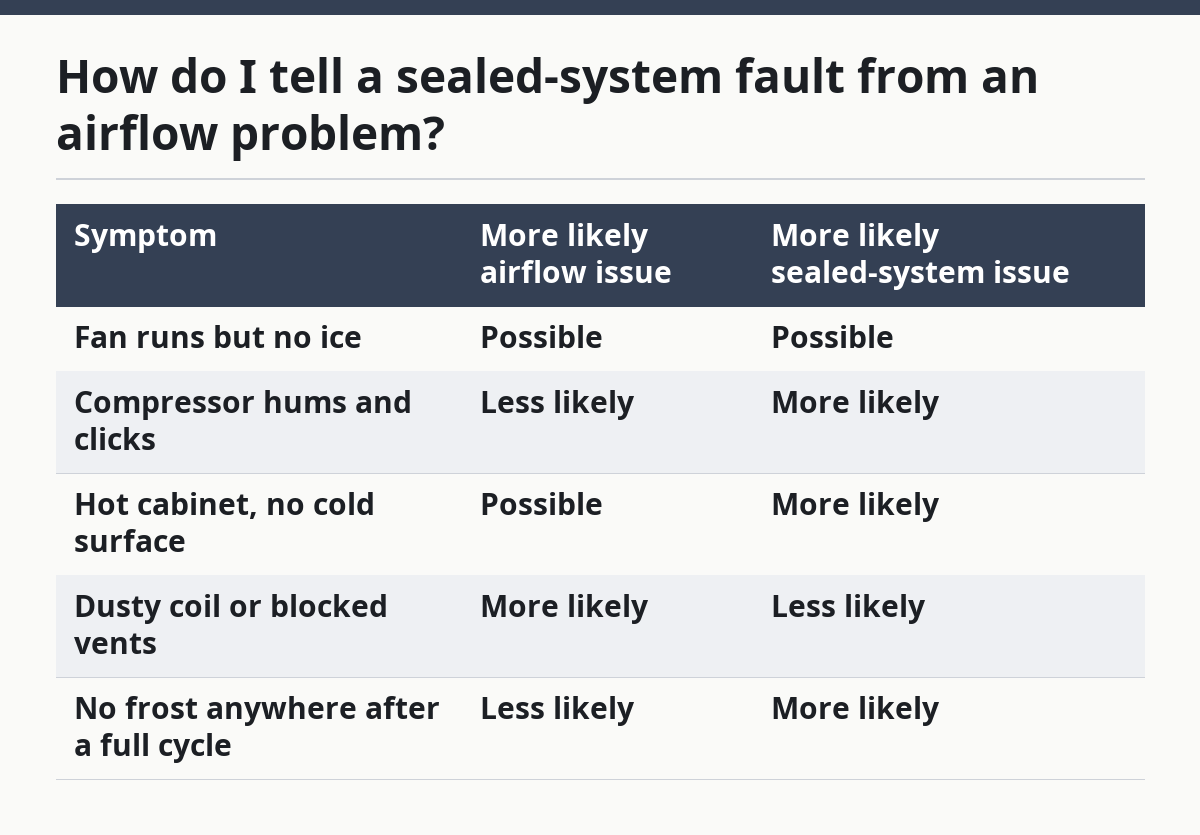
Airflow faults are worth fixing because they can mimic a bad compressor. Sealed-system faults are harder because the leak, blockage, or internal compressor wear sits inside the refrigeration loop. If the machine has a clean coil, clear vents, and still never gets cold, the problem has probably moved past airflow.
Could it be a refrigerant leak or capillary blockage?
Yes, a countertop ice maker refrigerant leak or a blocked capillary tube can produce exactly this symptom. In both cases, the compressor may run normally, but the refrigerant never reaches the right pressure change to create cold.
A leak usually means the sealed system has lost part of its refrigerant charge. The compressor can still move what is left, but the cooling effect drops off hard. A blockage does something similar from the other direction: the compressor pushes, but the capillary tube restricts flow so much that the evaporator never gets the refrigerant it needs.
As a result, this is the part many generic guides miss: a sealed-system fault is not the same as a “bad compressor” just because the machine is warm. The compressor may be spinning fine. The issue may be inside the tubing, the charge, or the internal valves, and those faults can present with the same boring symptom: no cold.
There are a few signs that lean toward sealed-system trouble:
- The compressor runs longer than normal with no useful chill.
- The tubing pattern never shows a clean hot-side/cold-side split.
- The machine makes no ice even though the fan and lights work.
- Cooling seems to fade over time rather than fail all at once.
This is the point where the repair choice gets blunt. A sealed-system repair on a portable ice maker is usually not a casual parts replacement. It can involve refrigerant handling rules under EPA Section 608, specialized tools, and labor that often makes sense only on higher-value equipment.
For example, if the capillary tube is blocked or refrigerant is gone, the machine is past the normal home-fix range.
For readers who want the broader decision tree, this article fits into the main portable ice maker troubleshooting guide and narrows the problem to the cooling side instead of the water or mold side.
What should I check before calling it dead?
You should check the basic electrical and thermal clues before deciding the compressor is broken. A machine with a running compressor but no cold can still have a fixable start problem, a blocked vent, or a loose connection.
Use this order:
- Confirm the outlet and cord are stable. If the unit only runs when moved or jiggled, the problem may be the cord or plug, not the compressor.
- Listen for a start click every time the machine tries to cool. Repeated clicking usually points to the start relay or overload path.
- Feel for airflow at the fan discharge. Weak airflow can cause hot running and poor cooling even with a good compressor.
- Check the back or side coil for dust. A dirty heat exchange coil can keep the system from shedding heat.
- Let the machine sit unplugged for 10 minutes, then restart it. If it briefly cools and then fails again, the fault is likely recurring and not a one-time overload trip.
The mistake is to assume that any warm machine has a dead compressor. That can lead to replacing the wrong part. The better approach is to separate the start circuit from the sealed system. If the relay is bad, the compressor may never get the start push it needs. If the relay is fine and the system still never gets cold, the compressor or sealed loop is the real problem.
A full compressor replacement on a portable unit is often hard to justify unless the rest of the machine is unusually valuable. A relay, coil cleaning, or wiring repair may be sensible. A refrigerant loss or capillary blockage is often the point where replacement becomes the practical choice.
When is repair not the right answer?
Repair is often not the right answer when the sealed system is the fault and the machine is low-cost. If the compressor runs, the fan runs, and the ice maker still never gets cold after a relay check and airflow check, the remaining fixes are usually sealed-system work.
That matters because sealed-system repair is not the same as swapping a switch. Refrigerant handling falls under EPA rules, and the machine may need service that is more technical than the rest of the unit deserves. If the unit is old enough that parts are scarce, the balance tilts even harder toward replacement.
The hard limit is simple: a portable ice maker with a bad hermetic compressor, a blocked capillary tube, or a refrigerant leak can move from “annoying” to “uneconomical” fast. That is not a judgment about the product; it is a repair-cost reality. The machine may still power on and sound normal while being beyond a sensible home fix.
This is also the point where a generic troubleshooting article often misleads people by promising one more reset, one more cleaning pass, or one more unplug cycle. Those steps help only when the fault is external or electrical. They do not restore lost refrigerant or remove an internal blockage.
If the compressor runs, the fan runs, and the cabinet still stays warm after basic checks, the honest answer is that the sealed system is likely the failure point. That is the line where diagnosis stops being useful and repair economics take over.
How to tell if countertop ice maker compressor is broken
A broken compressor usually shows up as a start failure, loud clicking, or a unit that runs without creating any useful cooling pattern. The compressor may hum, overload, or stay warm with no frost forming on the cooling side.
The key clue is that other parts can still work. The fan can spin, the lights can stay on, and the machine can still fail to get cold. If a known-good start relay does not change the behavior and the sealed system still shows no cooling, the compressor itself may be the fault.
Can you recharge refrigerant in a portable ice maker?
In practice, not as a normal home repair. A portable ice maker is a sealed system, so refrigerant loss usually means there is also a leak that must be found and fixed before any charge is added.
That work is subject to refrigerant handling rules such as EPA Section 608, and it is not the same as topping off a car tire. If the refrigerant is gone, the machine may also have a leak or blockage that makes recharging a temporary fix at best.
How to tell if countertop ice maker compressor is broken
A compressor that is truly broken usually fails to start, trips repeatedly, or runs without producing a clear hot-side/cold-side temperature change. The machine may hum, click, or stay warm even after the start relay is checked.
A sealed-system fault can look similar, so the compressor should not be blamed too fast. If the fan works, the relay looks sound, and there is still no cold after a normal run, the compressor is one possible cause, but not the only one.
Drafted with AI; not yet reviewed by a person.