
Last updated: November 16, 2026
Quick answer: in many portable ice makers, a restart loop is usually caused by a misread switch, a tray position problem, or a logic control board that never gets the freeze signal, and the first check is often a 5-minute power reset. A portable ice maker keeps restarting cycle without making ice when the control path is interrupted, so start with the water level, the ice basket, the tray tilt, and the limit switch before blaming the PCB control module.
Key takeaways
- A restart loop usually means the machine never reaches the part of the cycle that tells the compressor to keep freezing.
- The tray tilt positioning switch and limit switch are common trouble spots because a tiny misalignment can interrupt the signal.
- The infrared emitter can make the unit think the ice bin is full or empty at the wrong time.
- A reset helps only when the board is confused; it does not fix a stuck microswitch or a bad sensor position.
- If the machine restarts the same way after basic checks, the logic control board becomes a stronger suspect than the water supply.
What does the restart loop mean?

A restart loop means the machine keeps beginning the cycle again before it can freeze water into ice. On a portable ice maker, that usually points to a control problem, not a water problem alone, because the logic control board is waiting for a switch or sensor signal that never arrives.
That signal can come from a limit switch, a microswitch, the infrared emitter, or the tray position itself. If the board never gets the correct “ready” signal, the unit may dump, refill, pause, and start over without ever holding a long freeze cycle. In plain terms, the machine is acting busy while never getting to the part that makes ice.
One useful clue is timing. If the cycle stops and starts every few minutes, or if the compressor cuts out before the water tray can chill, the fault is often in the control path rather than the cooling system. That matters because a generic “reset it” answer misses the real issue: the board may be fine, but the signal feeding it is not.
This is the same kind of problem behind countertop ice maker resets continuously and ice machine cycle looping. The machine is not “choosing” to fail; it is being told, incorrectly, to begin again. That is why a practical fix often starts with the parts that tell the board what stage the machine is in.
For reference, appliance makers such as Whirlpool and GE document cycle-related faults in their support pages and owner manuals, because the board-sensor path is a common failure point in small ice makers. If the machine never reaches a stable freeze stage, that is the pattern to chase. For brand-specific guidance, see the Whirlpool support site and GE Appliances support, or consult a licensed appliance technician if the unit shows electrical damage.
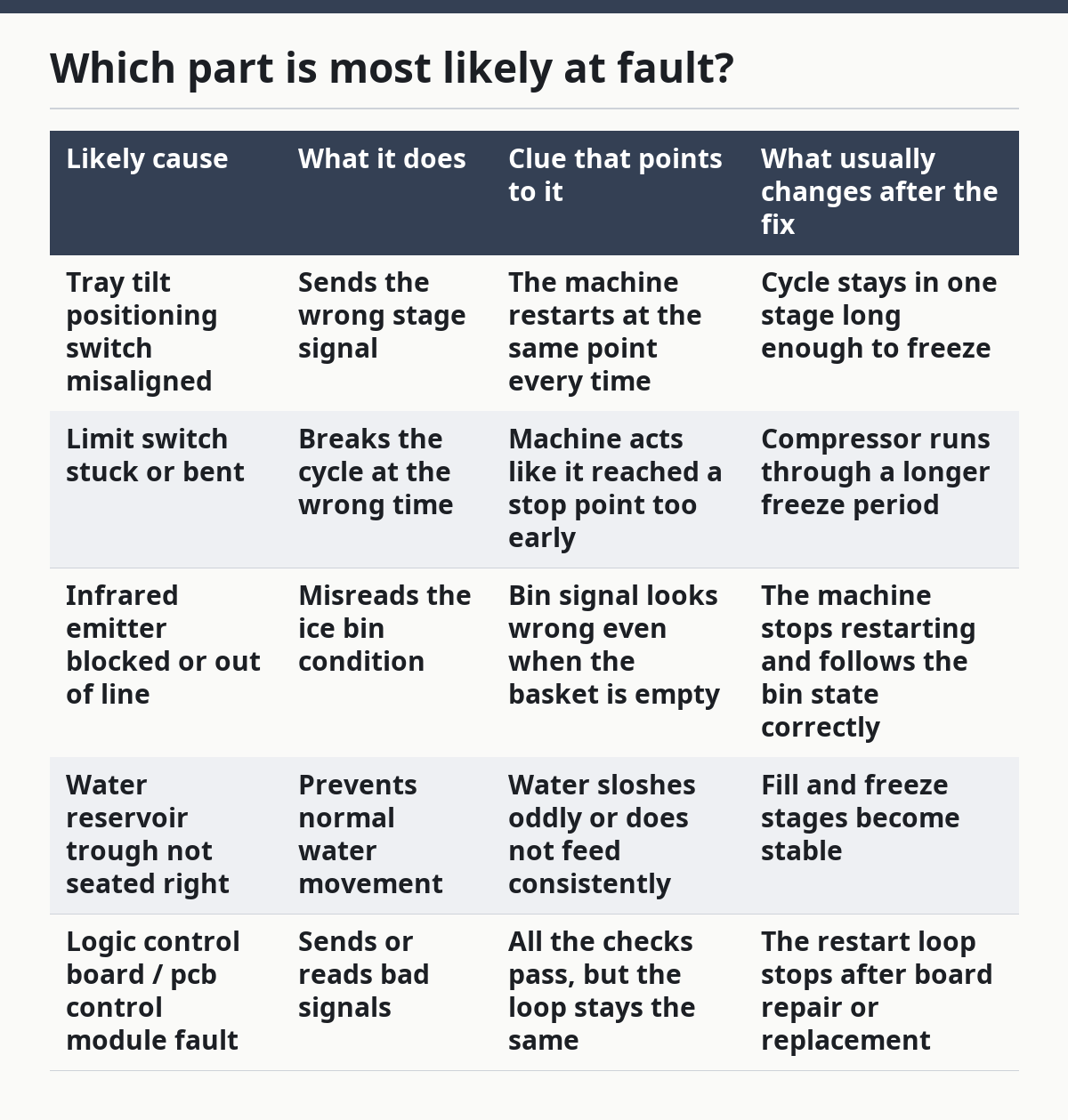
Which part is most likely at fault?
The most likely fault is the tray position or sensor path, because a small misalignment can stop the compressor signal before the freeze stage starts. In a portable machine, the logic control board depends on a chain of inputs, and one bad input can make the unit restart over and over.
Here is the order that often makes the most sense for a quick diagnosis, but for a brand-specific repair plan you should consult the owner’s manual or a professional technician and verify the steps against a source such as the Frigidaire support manuals.
| Likely cause | What it does | Clue that points to it | What usually changes after the fix |
|---|---|---|---|
| Tray tilt positioning switch misaligned | Sends the wrong stage signal | The machine restarts at the same point every time | Cycle stays in one stage long enough to freeze |
| Limit switch stuck or bent | Breaks the cycle at the wrong time | Machine acts like it reached a stop point too early | Compressor runs through a longer freeze period |
| Infrared emitter blocked or out of line | Misreads the ice bin condition | Bin signal looks wrong even when the basket is empty | The machine stops restarting and follows the bin state correctly |
| Water reservoir trough not seated right | Prevents normal water movement | Water sloshes oddly or does not feed consistently | Fill and freeze stages become stable |
| Logic control board / pcb control module fault | Sends or reads bad signals | All the checks pass, but the loop stays the same | The restart loop stops after board repair or replacement |
A generic article often blames the compressor first. That is too quick. If the compressor were the main issue, the machine would usually fail to freeze, not keep restarting in a neat pattern. A restart loop says the control logic is still active, which is why the board, switch alignment, and sensor path matter more than a guessed cooling fault.
Who this is not for: if the unit has physical damage, burnt wiring, or a power cord fault, stop here and do not keep cycling it. A restart loop from a control issue is one thing; visible electrical damage is another.
How do I check the logic control board and switches?

You check the logic control board and switches by working from the simplest signal path to the most hidden one, then watching whether the machine changes behavior after each step. This takes about 10 to 20 minutes and a screwdriver on most countertop units.
-
Unplug the ice maker for 5 minutes, then plug it back in.
This clears a confused control state on many portable units. If the board had glitched, the machine may complete a normal start sequence instead of looping right away. -
Remove the ice basket and look at the water reservoir trough.
The trough should sit cleanly in place with no crooked edge or debris under it. If the tray is tilted or not seated, the control path can treat that as an error and restart the cycle. -
Find the limit switch and press it gently by hand, if the design allows access.
You are checking for a sticky feel or a switch that does not move cleanly. A healthy switch should move and return without hesitation; a stuck one can interrupt the cycle before freezing begins. -
Inspect the tray tilt positioning switch for obvious misalignment.
The switch or actuator should line up with the tray path, not sit halfway off its stop. If realigning the tray changes the machine’s timing, you have found the problem. -
Check the infrared emitter line of sight.
Make sure nothing blocks the emitter path and that the sensor area is clean and dry. If the emitter is fooled, the machine may think it has reached a condition that tells it to restart. -
Run one short cycle and watch the timing.
If the machine now stays in the freeze stage longer, the control signal path was the issue. If it still restarts at nearly the same point, the logic control board or pcb control module moves higher on the list. -
If the behavior never changes, stop chasing the switches alone.
A board fault can look exactly like a switch fault from the outside. If the unit ignores every positional check, the control module may be reading the inputs wrong even when the parts themselves move correctly.
A useful way to think about it is this: the board does not make ice by itself. It waits for the tray, switches, and sensors to tell it when to keep going. When that chain breaks, the machine can loop for 1 minute, 2 minutes, or longer without ever settling into a freeze.
How do I realign a tray or switch problem?
Because a tray or switch problem can mimic a board failure, you realign the parts by correcting the physical position first. On a portable ice maker, even a small shift in the tray or stop tab can change the signal the board receives.
Start with the water reservoir trough. Make sure it sits flat and does not bind against the housing. If the trough is bumped out of place, the tray may not reach the same stop point it reached before, and the limit switch may never close the way the board expects.
Then check the tray tilt positioning switch. The goal is simple: the moving part must contact the switch fully, not just brush it. If the alignment is off by a small amount, the control board may read the stage as incomplete and send the unit back to the start of the sequence.
A clean sign that you have fixed it is a cycle that no longer resets at the same second or same stage. The machine should move from fill to freeze with a steadier pause. You do not need a stopwatch; you are looking for a change in behavior, not a perfect number.
A common mistake is forcing the tray into place. That can crack a plastic stop or bend the actuator, which turns a simple alignment issue into a parts problem. If the tray only fits when pushed hard, something is wrong with the seating path, not just the switch.
This is the part most generic guides miss: the board is often innocent. The restart happens because the board is doing its job with bad information. Correct the physical input, and the loop may end without replacing a thing.
When is the pcb control module the real problem?
The pcb control module is the real problem when the machine keeps restarting after every switch, sensor, and alignment check has already been corrected. At that point, the board is the part most likely misreading the signals or sending the wrong one back out.
A bad board often shows the same pattern every time. The machine powers up, runs a short sequence, and then drops back to the beginning even though the tray is seated, the infrared emitter is clear, and the limit switch seems to move normally. That repeatable pattern matters more than any single symptom.
Replacement is not a first step, because the board is more expensive and less obvious than a loose switch. Still, if the unit behaves the same after a proper reset and a careful alignment check, the control module becomes a stronger suspect than the water reservoir trough or the tray stop. That is especially true when the compressor never gets a stable freeze command.
A simple comparison helps:
| If you see this | Think first about | Why |
|---|---|---|
| Restart at the same point after 5 minutes of power-off | Logic control board | The machine may be stuck in a bad state |
| Restart stops after you reseat the tray | Tray tilt positioning switch | Physical alignment changed the signal |
| Restart changes when the ice basket is removed | Infrared emitter | The bin sensor is affecting the cycle |
| Restart stays the same after all checks | PCB control module | Inputs look normal, but the board still misreads them |
A board fault is not the only answer, but it is the right answer when the rest of the circuit looks normal. That is why a careful check of the switches and emitter comes before a replacement decision.
What mistakes make the cycle loop worse?
The most common mistake is guessing at the compressor before checking the control path, and that can waste an hour on the wrong fix. Another mistake is cleaning one sensor and calling the job done when the tray tilt or limit switch is still out of position.
Do not bend the switch arm to “make it work.” That can change the trigger point enough to create a new fault, and a small bend can outlast the original problem. If a switch only works when bent, it needs realignment or replacement, not force.
Do not keep restarting the unit over and over. Repeating the same failed cycle can hide the pattern and make a control issue look random. One or two test runs are enough to see whether the ice maker has moved past the restart loop.
Do not ignore the water reservoir trough just because the symptom sounds electrical. The trough affects how the machine advances through the cycle, and a crooked seat can mimic a board failure. That is why the mechanical path matters as much as the electronic one.
If the machine is still under warranty, check the support documents before opening the housing. Opening the case can change the repair path, and a simple external fix is better than turning a warranty issue into a parts job. For warranty or safety questions, use the manufacturer’s support page or an authorized service provider.
How do I know the problem is solved?
You know the problem is solved when the machine completes one full cycle without jumping back to the beginning. The best sign is a steady move from fill to freeze to harvest, with no restart before the compressor has time to work.
Watch for three changes. First, the unit should stop looping at the same stage. Second, the tray should stay in one position long enough to chill water. Third, the ice basket or sensor area should no longer trigger a false reset. If all three happen, the control path is likely stable again.
If the machine still restarts but only after a long pause, the fault may be intermittent. That usually means a switch is loose, a sensor is drifting, or the board is weak under heat and vibration. In that case, the machine is not fixed yet, even if it looks better for one run.
For broader help with related symptoms, the portable ice maker troubleshooting guide is the right place to step back and match the symptom to the part. You can also compare the pattern with a countertop ice maker reset guide or ice maker error codes page if your model uses a display.
FAQ
How do i do a hard reset on my portable ice maker?
A hard reset usually means unplugging the unit for 5 minutes, then plugging it back in and starting a fresh cycle. That clears some board glitches, but it will not fix a misaligned tray tilt switch, a sticky limit switch, or an infrared emitter that is reading the wrong state. If the loop returns right away, the issue is deeper than a reset.
Why does my ice machine start and stop every minute?
Your ice machine starts and stops every minute because the control board is getting a signal that tells it to restart before freezing is complete. That signal often comes from a mispositioned switch, a sensor problem, or a pcb control module that is reading the inputs wrong. If the pattern is exact and repeatable, the control path is the place to look first.
Can a dirty sensor cause a portable ice maker keeps restarting cycle without making ice?
Yes, a dirty or blocked sensor can cause a portable ice maker keeps restarting cycle without making ice because the board may think the bin is full or the stage is incomplete. Clean the sensor area gently, keep it dry, and check whether the restart timing changes after cleaning.
Should I replace the board or the switch first?
You should usually check the switch first because it is cheaper, easier to inspect, and more likely to be affected by alignment. Replace the board only after the tray, limit switch, infrared emitter, and water reservoir trough have all been checked and the problem still repeats.
When should I call a technician?
You should call a technician if you see burnt wiring, a damaged cord, a burnt smell, or a restart loop that continues after the basic checks. A technician can test the logic control board, switches, and wiring safely, and manufacturer support pages can point you to authorized service options.
Drafted with AI; not yet reviewed by a person.


One thought on “Portable Ice Maker Keeps Restarting Cycle Without Making Ice”